Solvent Selection
Solvents are a key area of focus for organic chemists looking to improve the greenness of their processes as they are usually the largest mass input of a synthetic process or transformation.
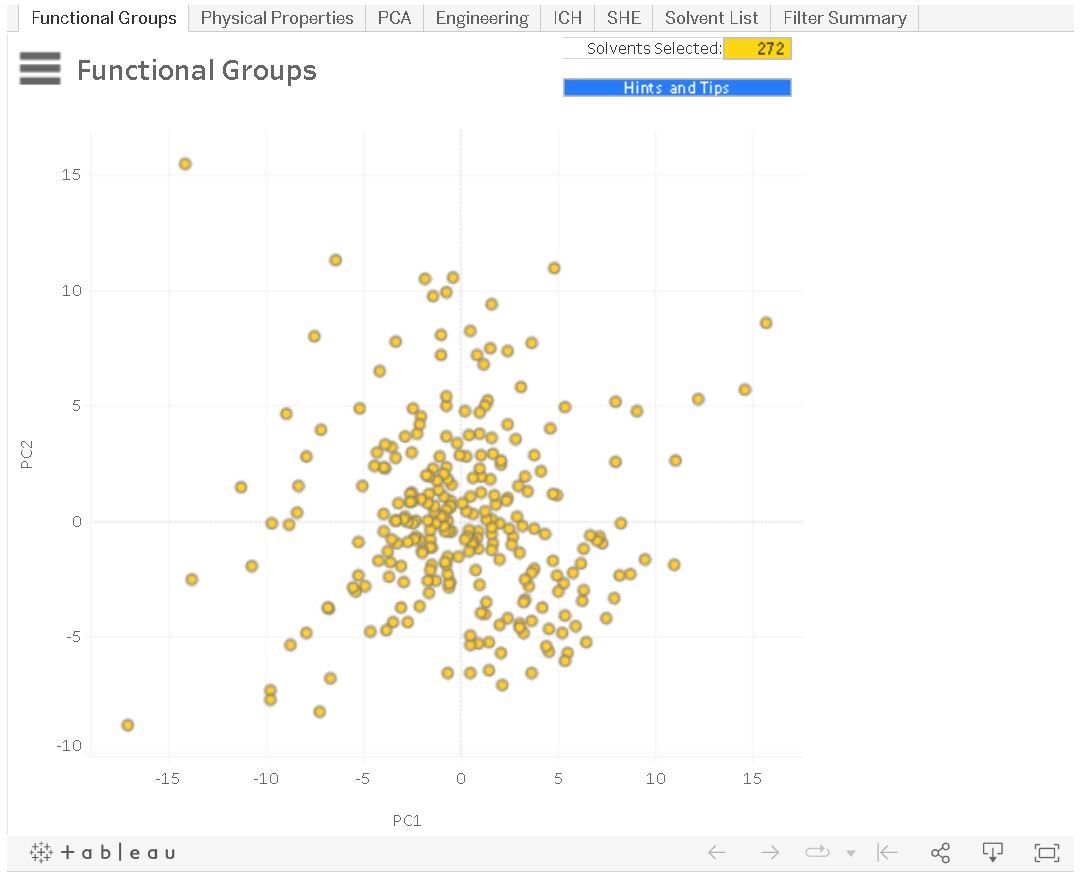
A comprehensive tool for evaluating a solvent or potential alternative is the ACS GCIPR interactive solvent guide (depicted below). This tool permits interactive solvent selection based upon the Principal Component Analysis (PCA) of the solvent's physical properties. Solvents which are close to each other in the map have similar physical and chemical properties, whereas distant solvents are significantly different. In addition, other data including the physical properties, functional groups, and environmental data has been included to aid the rational selection of solvents. This tool is further defined in "Toward a More Holistic Framework for Solvent Selection". Diorazio, L. J.; Hose, D. R. J.; Adlington, N. K., Org. Process Res. Dev. 2016, 20, 760-773.
Solvent Literature
- "CHEM21's selection guide of classical- and less classical-solvents". Prat, D.; Wells, A.; Hayler, J.; Sneddon, H.; McElroy, C. R.; Abou-Shehada, S.; Dunn, P. J. Green Chem. 2016, 18, 288-296. (open access)
- "Updating and Further Expanding GSK's Solvent Sustainability Guide". Alder, C. M.; Hayler, J. D.; Henderson, R. K.; Redman, A. M.; Shukla, L.; Shuster, L. E.; Sneddon, H. F. Green Chem. 2016, DOI: 10.1039/C6GC00611F
- "Green chemistry tools to influence a medicinal chemistry and research chemistry based organisation". Alfonsi, K.; et al. Green Chem. 2008, 10, 31-36.
- "Sanofi's Solvent Selection Guide". Prat, D.; et al. Org. Proc. Res. Dev. 2013, 17, 1517-1525.
- "Toward a More Holistic Framework for Solvent Selection". Diorazio, L. J.; Hose, D. R. J.; Adlington, N. K. Org. Proc. Res. Dev. 2016 (open access)
- "NMR Chemical Shifts of Trace Impurities: Industrially Preferred Solvents". Babij, N. R.; et al. Org. Process Res. Dev. 2016, 20, 661-667. (open access)
- "Development of GSK's NMR Guides". Gottlieb, H. E.; et al. Green Chem. 2016, DOI: 10.1039/C6GC00446F
- "A convenient guide to help select replacement solvents for dichloromethane in chromatography". Taygerly, J. P.; et al. Green Chem. 2012, 14, 3020-3025.
- "Replacement of dichloromethane within chromatographic purification". MacMillan, D. S.; et al. Green Chem. 2012, 14, 3016-3019.
- "Development of a tripartite solvent blend for sustainable chromatography". Chardon, F. M.; et al. Green Chem. 2014, 16, 4102-4105.
Reagent Selection
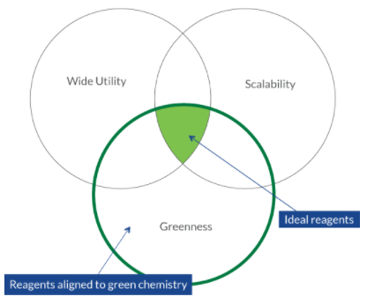
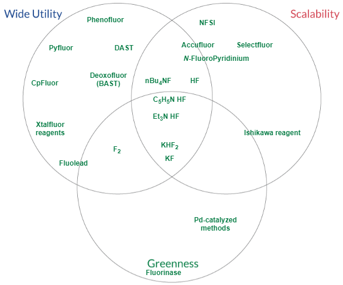
Selecting the most sustainable reagent to use for organic chemistry transformations requires the assessment of many factors including atom efficiency, toxicology, safety, waste products, sustainable feedstocks, and more. Industrial multidisciplinary chemists, as members of the ACS GCIPR, have compiled reagent guides to inform and assist organic chemists in the selection of reagents for >19 transformations or procedures.
Each guide, in the collection of guides, is a comprehensive resource composed of:
- A general overview of the transformation
- A Venn diagram representation
- General literature reviews
- Special considerations (e.g. safety) and green criteria
- List of reagents
- Mechanism
- Key references
- Scale-up examples
References
- ACS: Green Chemistry Institute's Pharmaceutical Roundtable
- "Development of GSK's Reagent Guides". Adams, J. P.; et al. Green Chem. 2013, 15, 1542-1549.
- "Development of GSK's Acid and Base Selection Guides". Henderson, R. K.; et al. Green Chem. 2015, 17, 945-949.
- "Evaluation of Alternative Solvents in Common Amide Coupling Reactions". MacMillan, D. S.; et al. Green Chem. 2013, 15, 596-600. (open access)
- "Development of a Solvent Selection Guide for Aldehyde-based Direct Reductive Amination Processes". McGonagle, F. I.; et al. Green Chem. 2013, 15, 1159-1165.
Biocatalysis Guide
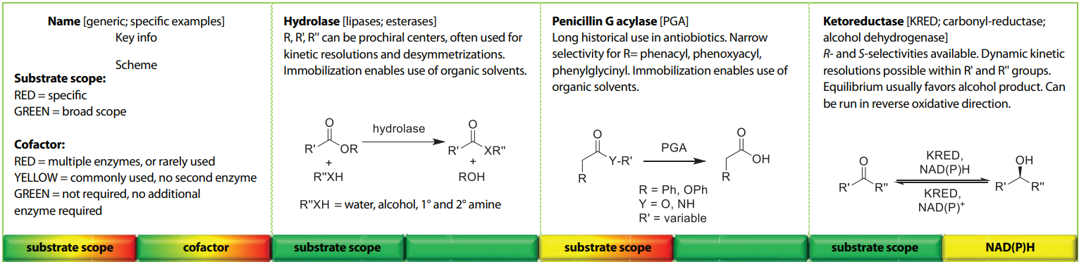
Biocatalysis is a key green technology for modern sustainable organic syntheses. The Biocatalysis Guide is a simple double-sided, single-sheet guide to the currently most used enzyme classes amongst the ACS GCI member companies. It has been produced to be an easy-to-follow guide for chemists who have not had significant exposure to biocatalysis, showing generic transformations that are available so these can be factored into retrosynthetic analysis.
Med Chem
All parts of pharmaceutical development can be made more sustainable. A great example of this is the ACS GCIPR Medicinal Chemistry Team's approaches to greening medicinal chemistry. The team produced this quick guide covering purification, solvent selection, reagents, energy and resources.
Process Mass Intensity
Process mass intensity (PMI) is the key green mass-based metric for measuring the resource usage impact of a synthetic chemistry process.
$$PMI = \frac{\text{Mass of Raw Materials Input}}{\text{Mass of Product}}$$
The PMI calculator enables organic chemists to quickly determine the PMI number from the raw material inputs and final product yield. The calculator accommodates multi-step convergent syntheses and includes breakdown of solvent, reagents, and water PMI.
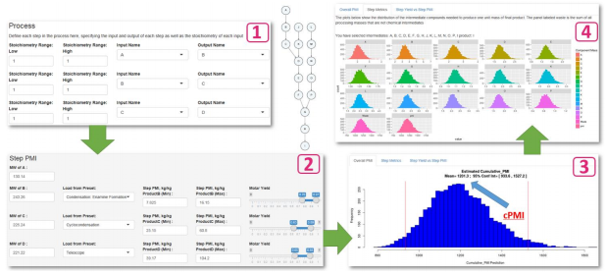
The PMI prediction tool (depicted below) provides a simple and accessible means of predicting the mass efficiency of proposed synthetic routes. The tool is built from a dataset of nearly two thousand multi-kilo reactions provided by pharmaceutical, biotech, and manufacturing companies via the ACS GCIPR as well as extracted from the literature.
This process is elaborated in "The PMI Predictor app to enable green-by-design chemical synthesis". Borovika, A.; et al. Nature Sustainability. 2019, 2, 1034-1040.
References
- ACS Sustainable Chem. Eng. 2022, 10, 5148-5162
- mAbs: Budzinski, K.; et al. New Biotechnology, 2019, 49, 37-42
- Oligonucleotides: Andrews, B.I.; et al. J. Org. Chem. 2021, 86, 49-61
Green Chemistry Innovation Scorecard Calculator
Green Chemistry Innovation Scorecard Calculator is a slightly different approach to accounting for PMI by focusing on waste. A joint effort by the IQ Consortium, ACS GCI Pharmaceutical Roundtable, and academic leaders, this web calculator illustrates how green chemistry and engineering innovation can reduce waste mass during bulk active pharmaceutical manufacture. The calculator uses a statistical analysis of 64 bulk active pharmaceutical manufacturing processes encompassing 703 steps across 12 companies to provide a relative process greenness score.
References
- ACS Sustainable Chem. Eng. 2022, 10, 5148-5162
- "Using the Right Green Yardstick". Jimenez-Gonzalez, C.; et al. Org. Process Res. Dev. 2011, 15, 912-917.
General Resources
- Beyond Benign — green chemistry education
- The CHEM21 metrics toolkit
- ACS: Green Chemistry MedChem Tips and Tricks
- Wikipedia's Green Chemistry
- Wikipedia's Green Chemistry Metrics
- Green and Sustainable Medicinal Chemistry, ed. Summerton, Sneddon, Jones, Clark; RSC, 2016. DOI: 10.1039/9781782625940
- Green Chemistry Strategies for Drug Discovery, ed. Peterson, Manley; RSC, 2015. DOI: 10.1039/9781782622659