
Interpreting a 1H nmr spectrum I

The following 1Hnmr spectrum of a C10H12O2 compound was obtained on a 90 MHz spectrometer.
A series of questions are presented below the spectrum. To answer each question enter a number or letter in the designated answer box.
Do not enter punctuation (eg. commas or semicolons) or spaces.
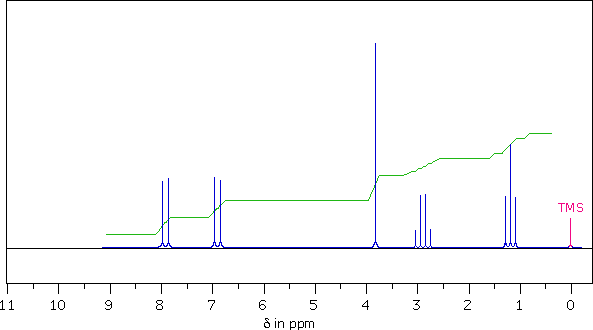
90 MHz 1H NMR spectrum of C10H12O2 with integrator trace; signals at 7.9, 6.9, 3.8, 2.9, 1.2 ppm and TMS at 0

1. Ignoring the TMS signal at δ = 0, how many discrete groups of proton signals are present in this spectrum? ...
2. What is the multiplicity (s, d, t, q) of the highest field signal from this sample? ...
3. The sample has a singlet at δ = 3.8 ppm. In units of Hertz (Hz) how far is this signal from the TMS signal? ...
4. What structural feature is suggested by the singlet at δ = 3.8 ppm? ...
A CH3–C=O B –CH2C –O–H D –O–CH3E C–CH3F C=C–H
5. From multiplet line separations (Js), which of the other signals is coupled to the quartet at δ = 2.9 ppm? ...
A δ = 1.2 ppm B δ = 3.8 ppm C δ = 6.9 ppm D δ = 7.9 ppm

6. Using the integrator trace and the formula of the sample, assign a whole number ratio to the sample signals as follows:
7.9 ppm signal; 6.9 ppm signal; 3.8 ppm signal; 2.9 ppm signal; 1.2 ppm signal


7. You should now be able to assign a structure to this C10H12O2 compound. To evaluate your assignment Click Here.