HomeReuschVirtual Textbook Practice ProblemsInterpreting a 1H NMR Spectrum I

Interpreting a NMR Spectrum

The following 1Hnmr spectrum of a C10H12O2 compound was obtained on a 90 MHz spectrometer.
A series of questions are presented below the spectrum. To answer each question enter a number or letter in the designated answer box.
Do not enter punctuation (eg. commas or semicolons) or spaces.
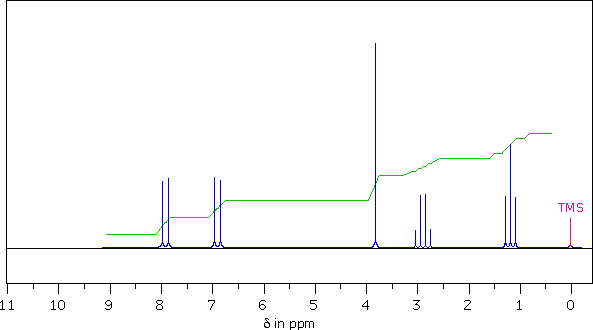

1. Ignoring the TMS signal at δ = 0, how many discrete groups of proton signals are present in this spectrum? ...
2. What is the multiplicity ( s, d, t, q ) of the highest field signal from this sample? ...
3. The sample has a singlet at δ = 3.8 ppm. In units of Hertz (Hz) how far is this signal from the TMS signal? ...
4. What structural feature is suggested by the singlet at δ = 3.8 ppm? ...
A CH3–C=O B –CH2C –O–H D –O–CH3E C–CH3F C=C–H
5. From multiplet line separations (Js), which of the other signals is coupled to the quartet at δ = 2.9 ppm? ...
A δ = 1.2 ppm B δ = 3.8 ppm C δ = 6.9 ppm D δ = 7.9 ppm

6. Using the integrator trace and the formula of the sample, assign a whole number ratio to the sample signals as follows:
7.9 ppm signal; 6.9 ppm signal; 3.8 ppm signal; 2.9 ppm signal; 1.2 ppm signal


7. You should now be able to assign a structure to this C10H12O2 compound. To evaluate your assignment Click Here.