Degenerate Cope Rearrangement & Bullvalene
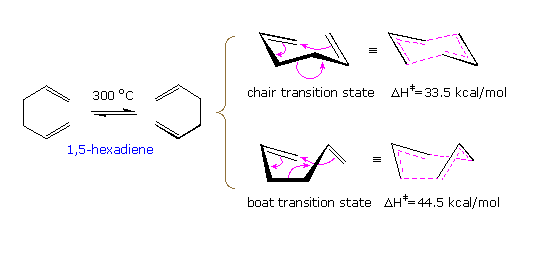
The simplest Cope rearrangement is the degenerate rearrangement of 1,5-hexatriene. As drawn in the following diagram, this [3.3]-sigmatropic shift may take place by one of two transition states, a lower energy chair state or a higher energy boat state. Because the product is identical with the reactant, isotopic labeling is needed to establish that change has occurred. The relatively high activation energy of this reaction requires a temperature near 300 °C.
If ring strain is relieved in this rearrangement, as in the case of cis-1,2
-divinylcyclopropane, the activation energy is substantially reduced so that conversion to
1,4-cycloheptadiene occurs below 20 °C within 30 minutes, as shown above by clicking on the
diagram. This rearrangement becomes degenerate for the compound bicyclo[5.1.0]octa-2,7-diene,
and the activation energy is further reduced. In both cases a boat transition state is forced by
structural constraint.
If tricyclic analogs are formed by bridging the C1 and C8 carbons of
bicyclo[5.1.0]octa-2,7-diene, similar degenerate rearrangements are observed. Examples will be
displayed above by clicking on the diagram again. For three of these compounds the activation
energy is even lower due to a combination of increased ground state strain and transition state
stabilization by interallylic bonding. The remarkable C10H10 hydrocarbon
bullvalene is exceptional in two respects. First, its ground state is stabilized relative to the
dihydro analog by π-conjugation with the three-membered ring. Second, its three-fold symmetry
permits numerous self-replicating Cope rearrangements leading to over a million
(10!/3=1,209,600) identical valence tautomers. All the carbons and hydrogens in bullvalene
appear to be equivalent on the nmr time scale at 100 °C, and cannot be discriminated until
cooled to -15 °C. Molecules of this kind are termed fluxional. It is important to
recognize that valence tautomerization of this kind is not resonance (the relative
positions of the atoms undergo small changes).
Bullvalene
|
|---|