If you are asked to write a IUPAC name for a compound, pay careful attention to the syntax of this nomenclature system. For example, commas and dashes must be used in precisely the correct manner, and extra spaces must be avoided. Spelling must also be absolutely correct. Computers (and some instructors) are unforgiving when it comes to judging the names you submit.
Question 6: Alcohol Nomenclature
Part A: The line formula for a compound is shown below. |
What IUPAC nomenclature suffix (ending) should be used for this compound? | ||
| How many carbon atoms are in the longest carbon chain? | |||
| How many carbon atoms are in the longest chain bearing the hydroxyl group? | |||
| Give the IUPAC name for this compound. |
Part B: The formula for a substituted carbocyclic compound is shown below.
 |
What IUPAC nomenclature suffix (ending) should be used for this compound? | ||
| In numbering the ring, which carbon (a-f) is #1? | |||
| In numbering the ring, which carbon (a-f) is #2? | |||
| Give the IUPAC name for this compound. |
Part C: The formula for another carbocyclic compound is shown below.
 |
Give the IUPAC name for this compound. |
Part D: The formula for a difunctional compound is shown below.
 |
What IUPAC nomenclature suffix (ending) should be used for this compound? | ||
| Give the IUPAC name for this compound. |
Part E: (CH3)2CHCH2CH(OH)CH2CH3
| Give the IUPAC name for this compound. |
Part F: CH2=C(C2H5)CH2C(CH3)2OH
| Give the IUPAC name for this compound. |
Question 7: Aldehyde & Ketone Nomenclature
Part A: A line formula for a compound is shown below. |
What IUPAC nomenclature suffix (ending) should be used for this compound? | ||
| How many carbon atoms are in the longest carbon chain? | |||
| How many alkyl substituents are on this chain? | |||
| Give the IUPAC name for this compound. |
 |
What IUPAC nomenclature suffix (ending) should be used for this compound? | ||
| How many carbon atoms are in the root chain? | |||
| How many alkyl substituents are on this chain? | |||
| Give the IUPAC name for this compound. |
 |
In numbering the ring, which carbon (a-g) is #1? | ||
| Give the IUPAC name for this compound. |
| (1) | (C2H5)2CHCH2COCH3 | Enter the IUPAC name | ||
| (2) | (CH3)2C=CHCH(CH3)CH2CHO | Enter the IUPAC name | ||
| (3) | (CH3)3CCOCH2CH2COC(CH3)3 | Enter the IUPAC name | ||
| (4) | CH3COCH2CH(OH)CH2OH | Enter the IUPAC name | ||
| (5) | C6H5CH2COCOC2H5 | Enter the IUPAC name | ||
| (6) | O=CHCH2CH2CH(CHO)CH2CH=O | Enter the IUPAC name |
Question 8: Carboxylic Acid Nomenclature
Part A: A line formula for a compound is shown below. |
How many carbon atoms are in the root chain? | ||
| How many alkyl substituents are on this chain? | |||
| Give the IUPAC name for this compound. |
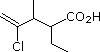 |
How many carbon atoms are in the root chain? | ||
| Give the IUPAC name for this compound. |
 |
Give the IUPAC name for this compound. |
| (1) | (CH2=CH)2CHCH2CO2H | Enter the IUPAC name | ||
| (2) | HO2CCH2CH(CH2CH=CH2)CH2CH(C2H5)CO2H | Enter the IUPAC name | ||
| (3) | CH3CH(CO2H)CH(CO2H)CH2CO2H | Enter the IUPAC name |