EI-MassSpectra of Assorted Organic Compounds
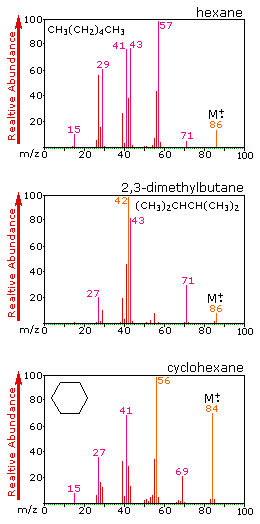
The mass apectra of three different saturated hydrocarbons are displayed below. Two are isomeric hexanes and the third is cyclohexane. Comments regarding the fragmentation patterns are presented in the box to the right of each spectrum. Ions are sometimes characterized by loss of a specific neutral fragment from the molecular ion. For example, a M-15 ion is identified as loss of a methyl group. Odd-electron ions, including the molecular ion, are colored orange when marked. Even-electron ions are colored magenta. The "Toggle Examples" button at the bottom will display a different set of spectra in which the influence of a particular functional group may be examined. Repeated clicking of this button will cycle through fifteeen spectra. In each example the molecular ion is designated by M •+.
 |
|
End of this supplementary topic
Common Fragment Ions and Neutral Fragments
|
|
||||||||||||||||||||||||||||||||||||||||||||||||||||||||||||||||||||||||||||||||||||||||||||||||||||||||||||||||||||||||
End of this supplementary topic
Rearangement Mechanisms in Fragmentation
|
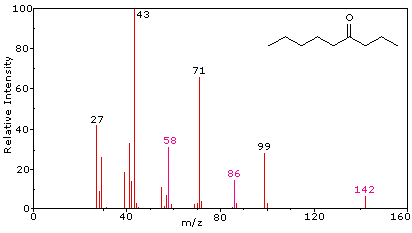
4-nonanone |
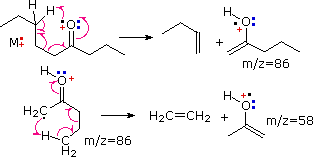
The odd-electron fragment ions at m/z = 86 and 58 are the
result of a McLafferty rearrangement, involving the larger alkyl
chain, and a subsequent loss of ethene (the "double-McLafferty"
rearrangement). |
|---|---|
|
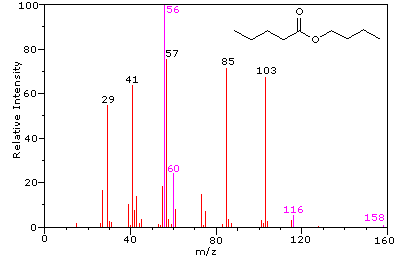
butylpentanoate |
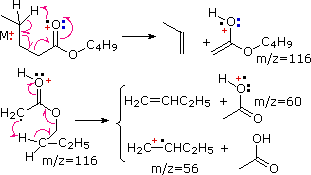
Alpha-cleavage gives ions at m/z=57 & 85 Da. The
McLafferty rearrangement on the acid side generates a m/z=116
ion. Subsequent rearrangement on the alcohol side generates
m/z=60 and 56 ions. The m/z=103 ion is probably
C4H9CO2H2(+). |
|
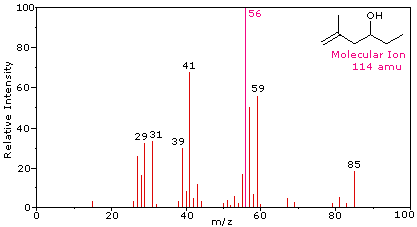
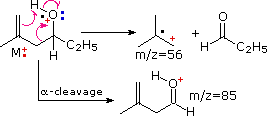
5-methyl-5-hexen-3-ol |
|
|
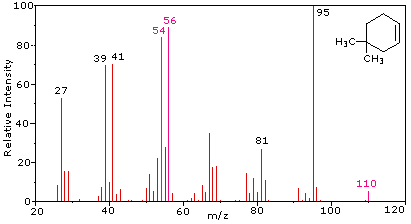
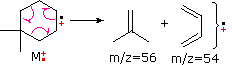
4,4-dimethylcyclohexene |
|