Alkyne Addition Reaction Examples
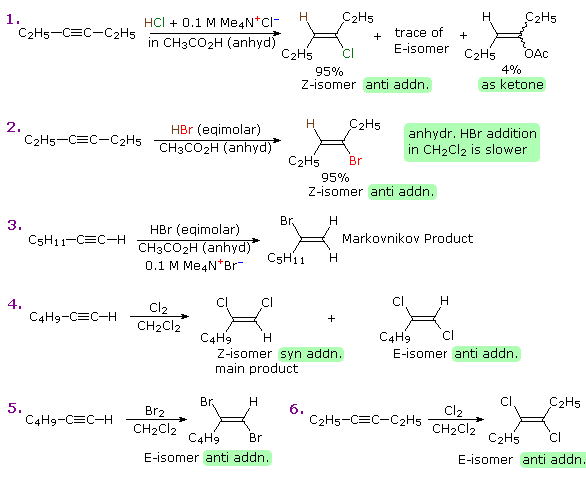
Examples of electrophilic addition reactions to various alkynes are shown in the following diagram. Whereas both 1-heptyne and 4-octyne were unreactive when treated (1 hr.) with a saturated solution of HCl in methylene chloride, using the polar hydrogen bonding solvent, acetic acid, and increasing the concentration of halide anion provided significant rate enhancement and stereoselectivity (examples 1-3). This is attributed to stabilization of an initially formed pi-complex (vide infra) and competition between AdE2 and AdE3 (Addition-Electrophilic-Bimolecular versus Addition-Electrophilic-Termolecular) mechanisms. Although chlorine addition to a terminal alkyne in methylene chloride gave an isomer mixture with the syn-addition isomer predominating (example 4), bromine addition was cleanly anti.
Reactions of similar alkynes conjugated with a phenyl group will be shown above by clicking on the
diagram. Such reactions are often faster than those with alkyl substituted triple bonds, but are
less stereoselective. Molecular rearrangements are seldom observed in any additions of HX to
alkynes, suggesting that carbocation intermediates are not significant intermediates.
As noted in the discussion of alkene reactions, the initial interaction between an electrophile and an alkene or alkyne is the formation of a pi-complex, in which the electrophile accepts electrons from and becomes weakly bonded to the multiple bond. Such complexes are formed reversibly and may then reorganize to a reactive intermediate (e.g. a carbocation or a halonium cation) in a slower, rate-determining step. Subsequent reaction then leads to addition products. The following diagram shows the role of a pi-complex in reactions of alkenes with Brønsted acids and halogens. Polar solvents often help to stabilize these pi-complexes.
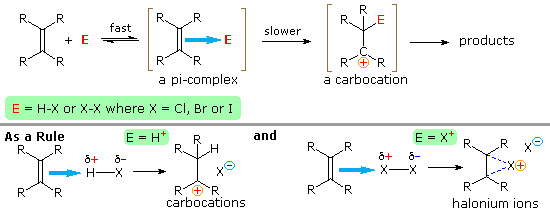
Equivalent pi complexes are expected to form in similar reactions of alkynes, as will be shown above by clicking on the diagram. Since the corresponding reactive intermediates from these complexes are relatively unstable, subsequent reactions will have higher activation energies and the sluggish reactivity of alkynes becomes understandable. In this respect, the relative stability of vinyl cations to their sp3 equivalents has been determined as follows:
|
Carbocation Stability |
CH3(+) | ≈ | RCH=CH(+) | < | RCH2(+) | ≈ | RCH=CR(+) | < | R2CH(+) | ≈ | CH2=CH-CH2(+) | < | C6H5CH2(+) | ≈ | R3C(+) |
|---|---|---|---|---|---|---|---|---|---|---|---|---|---|---|---|
| Methyl | 1°-Vinyl | 1° | 2°-Vinyl | 2° | 1°-Allyl | 1°-Benzyl | 3° |
It is possible that vinyl cations stabilized by conjugation with an aryl substituent are intermediates in HX addition to the alkynes in examples 7 & 8 (above). If so, the ion pair formed by collapse of the pi-complex may give syn addition by an AdE2 process or, with added halide anion, anti addition by an AdE3 mechanism. A similar partitioning of the pi-complex into syn and anti pathways takes place in many other cases. The addition of finely divided silica or alumina to methylene chloride solutions of alkynes has been found to accelerate addition of HX, generated in situ from SOX2 or AcX.