Six-Membered Ring Conformations
Cyclohexane Derivatives
Conformations of cyclohexane and its simple substituted derivatives have been described elsewhere in this text. The chair conformation is the favored configuration, and bulky substituents prefer to occupy an equatorial location. The left hand structures and table in the following diagram summarize the free energy differences between equatorial and axial orientations of some simple groups. These energies are commonly reported as A values. An axial methyl group is hindered by two gauche butane interactions, each accounting for ca. 0.9 kcal/mol. Since an axial ethyl group may rotate so that it appears no larger than a methyl to the remaining axial hydrogens on the same side of the ring, its A value is the same as methyl. Larger alkyl groups have increased A values, commensurate with increased crowding with the axial hydrogens. The trimethylsilyl group has a value half that of a tert-butyl group, reflecting the longer bond length of C–Si. For a table of common A values Click Here.
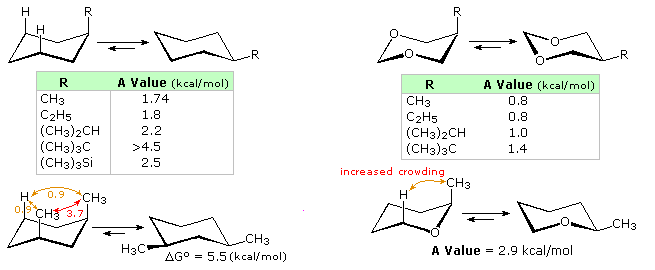
The heterocyclic compounds on the right side of the diagram illustrate the decreased axial hinderance that results from the absence of nearby axial hydrogens. From the smaller but significant energy differences shown, it may be concluded that the steric hindrance of non-bonding electron pairs on oxygen cannot be ignored. Other factors in these cases are the shorter bond length and tighter C-O-C angle, which may act to increase hindrance, as shown by the lower right example.
Cyclohexene Derivatives
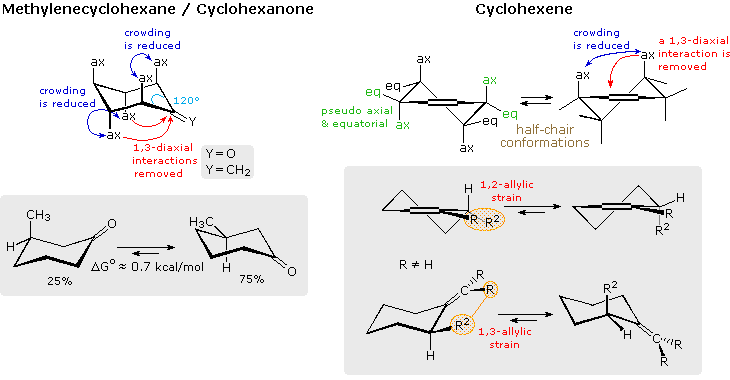
Inserting a double bond into a cyclohexane ring (exo or endo) introduces distortion that influences structural and chemical behavior. In the case of an exocyclic double bond, an axial hydrogen is removed from one side of the ring, and the increased bond angle at the sp2-carbon expands some of the remaining axial:axial distances. The conformational preference for an equatorial methyl substituent in 3-methylcyclohexanone is thereby reduced, as shown on the left of the following diagram. However, the change in bond angle perturbs the strain free cyclohexane configuration to such a degree that double bond addition reactions are exceptionally favored. Thus, the heat of hydrogenation of methylenecyclohexane is roughly 1 kcal/mol greater than that of methylenecyclopentane or methylenecycloheptane. Furthermore, the rate and equilibria constants for addition reactions of cyclohexanone are greater than those for comparable reactions of similar ketones.
|
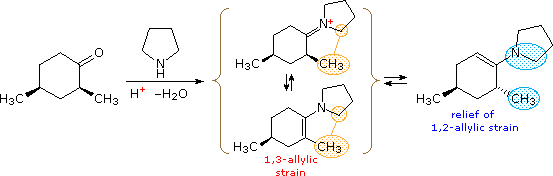
The endocyclic double bond in cyclohexene produces an even greater change in structure, as illustrated on the right side of the above diagram. The planar configuration of the double bond favors a pair of half-chair conformations, having a 5.3 kcal/mol equilibrium barrier. A model of a twist chair is displayed on the right. Twisting of the allylic carbons skews the orientation of their axial and equatorial bonds into pseudo axial or equatorial directions. These locations may be identified in the model by clicking the last button. Allylic strain exists when an equatorial allylic substituent is hindered by a substituent on the double bond. A good example of how this strain may influence the course of a reaction is found in enamine formation from α-substituted cyclohexanones. The following equations are typical. Most significantly, the enamine double bond is generally formed away from the α-substitution, especially with pyrrolidine. The A 1,3-strain shown in the bracketed formulas is undoubtedly responsible for this regioselectivity. Second, when a reference point exists, the α-substituent is found to be axial in the final product, reflecting A 1,2-strain.
|
|