Birch Reduction
A facile reduction of benzene and substituted benzenes is achieved by treatment with the electron rich solution of alkali metals, usually lithium or sodium, in liquid ammonia. This reaction, which is called the Birch Reduction in honor of Australian chemist A.J.Birch, is related to the reduction of alkynes to trans-alkenes. Reduction is believed to occur by a stepwise addition of two electrons to the benzene ring, each electron addition being followed by a protonation, as illustrated in the following diagram. The initial electron addition gives a radical-anion for which many resonance contributors may be written. Following delivery of a proton by the weak acid ammonia, the resulting delocalized radical accepts a second electron to give an anion. The anion generated by the second electron addition is delocalized over three carbon atoms, and is protonated on the central carbon. The isolated (unconjugated) double bonds in the product do not react under these conditions.

|
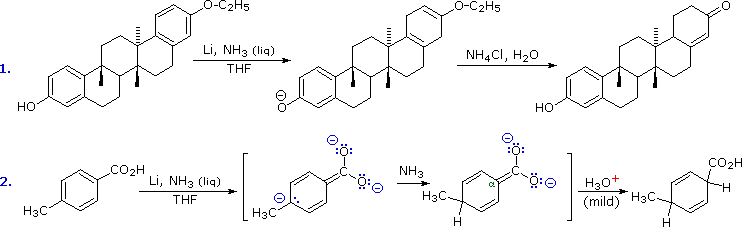
When substituents are present, they may influence the regioselectivity of the Birch reduction. The product is determined by the site of the first protonation, since the second protonation is nearly always opposite (para to) the first. Electron-donating substituents such as ethers and alkyl groups favor protonation at an unoccupied site ortho to the substituent; whereas electron-attracting substituents such as carboxyl favor para protonation. The influence of a carboxyl group dominates poly substituted rings, and alkoxy groups have a greater directing influence than alkyl substituents. An oxy anion group, as in the conjugate base of phenol, prevents reduction from occurring. Two examples of such Birch reductions are shown below. Although the substrate molecule in the first reaction may appear very complex, it is essentially a rigid framework with a benzene ring at each end. The phenolic function on the left hand ring becomes a phenolate anion under the reduction conditions, and does not react further. The right hand aromatic ring is an ether, and it reduces as expected. The carboxylic acid in the second example is immediately converted to its conjugate base. Although this carboxylate anion is negatively charged, it still has an electrophilic carbon atom which acts to stabilize an adjacent negative charge as shown. After protonation of the para carbanion by ammonia, the carboxylate dianion remains unchanged until it is doubly protonated by a strong acid, such as NH4(+) or H3O(+).
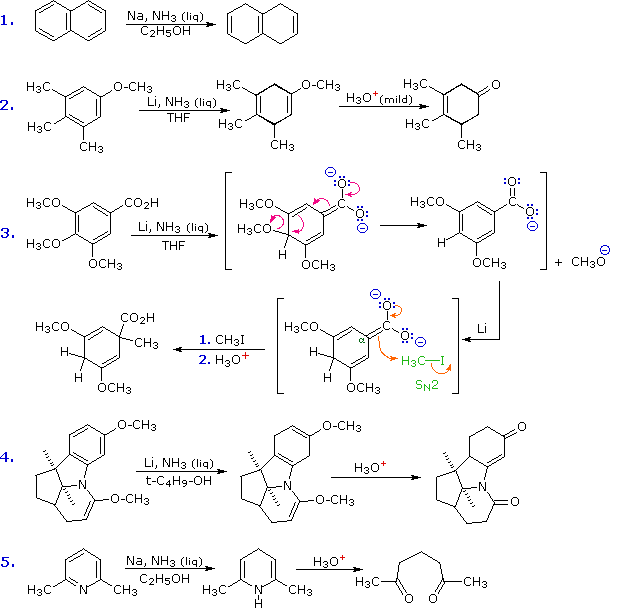
Further examples of Birch reductions are presented in the following diagram. The preference for protonation at unsubstituted sites (unless electron withdrawing groups are present), and for unconjugated products is again illustrated in the first reaction. Note that the isolated double bonds are not reduced at the low temperatures of refluxing liquid ammonia (–33 °C). Reactions #2 & 4 illustrate a particularly useful application of the Birch reduction. Aryl ethers are reduced to 1,4-dienes, as expected, but one of the double bonds is an enol ether and is readily hydrolyzed to the corresponding ketone. If mild acid catalysis is used, the other double bond remains unchanged; more vigorous acid (or base) treatment shifts this double bond to a conjugated location if simple proton shifts permit. The 3rd reaction again illustrates the regio-directive influence of a carboxyl group, even in the carboxylate form. The alpha-anion is sufficiently stable that it may induce an elimination reaction (first stage) and upon regeneration be alkylated by a reactive alkyl halide (second stage). The last example shows the Birch reduction of pyridine to a bis-enamine, hydrolysis of which gives a diketone.