Allene Chemistry
The simplest cumulated diene is 1,2-propadiene, CH2=C=CH2, also known as allene. Indeed, cumulated dienes are often called allenes. The central carbon in such compounds is sp-hybridized (it has only two bonding partners), and the double bond array is linear as a result. Since the π-bonds of allenes are orthogonal, the planes defined by the end carbon substituents are also orthogonal. As shown in the following diagram, the overall configuration of allenes resembles that of an elongated tetrahedron. An interesting consequence of this configuration is that allenes having two different substituents on each of the terminal carbon atoms are chiral.
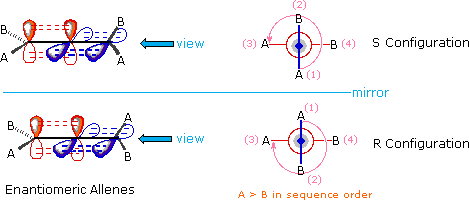
The above diagram shows an allene with different substituents (A & B) on each of the terminal (sp2) carbon atoms. The enantiomeric configurations are displayed relative to a mirror plane placed to illustrate their mirror-image relationship. To assign a stereochemical prefix, i.e. R or S, to these configurations we must view them from one end (it doesn't matter which), as shown in the Newman-like projection on the right. If the sequence order of substituents is A > B, then the two substituents nearest the viewer are assigned a ranking of 1 (A) and 2 (B), while the remote substituents are given rankings of 3 (A) and 4 (B). Applying the viewing rule then leads to the configurational notation shown above. This procedure may be used even when the A & B substituents on one sp2 carbon are different from those on the other sp2 carbon.
Models of 2,3-pentadiene enantiomers may be examined by Clicking Here .
For additional information about chiral axes and planes Click Here.
More than two double bonds may have a cumulated structure, as we find in 1,2,3-butatriene (CH2=C=C=CH2) and 1,2,3,4-pentatetraene (CH2=C=C=C=CH2). The carbon atoms in such cumulenes all have a linear configuration, but the configuration of the terminal substituents depends on the number of cumulated double bonds. For an even number of double bonds, an orthogonal configuration of terminal substituents (as in allene) will be observed. For an odd number of double bonds, the terminal substituents and all the carbons between them will lie in a plane. If the terminal substituents at each end are different, the even double bond compounds will have enantiomeric stereoisomers; whereas, the odd double bond compounds will exist as cis-trans diastereoisomers.
Some instructive physical properties of a simple cumulated diene, 1,2-butadiene, compared with its conjugated diene and alkyne isomers are presented in the following table. From the heats of hydrogenation we see that the methylallene is thermodynamically the least stable of these isomers, with the conjugated diene being most stable. The ionization potential is intermediate between the alkyne and the conjugated diene (note than an electron volt is equivalent to 23.05 kcal/mol), suggesting that the pi-electrons in the allene are less strongly bound than in the alkyne. Finally, the gas phase basicity or proton affinity is close to that of the conjugated diene, and slightly greater than that of the alkyne.
| Compound | Heat of Hydrogenation | Ionization Potential | Proton Affinity |
|---|---|---|---|
| 1,2-Butadiene | -69.5 kcal/mol | 9.20 e.v. | 180-186 kcal/mol |
| 1,3-Butadiene | -56.6 | 9.07 | 181-187 |
| 2-Butyne | -65.1 | 9.58 . | 179-185 |
Addition Reactions of Allenes
Allenes undergo the usual electrophilic addition reactions, and one of the double bonds may even serve as a dienophile in a Diels-Alder reaction. However, the regioselectivity of electrophilic addition may seem surprising when examined with reference to the generally accepted order of cation stability.
|
Carbocation Stability |
CH3(+) | ≈ | RCH=CH(+) | < | RCH2(+) | ≈ | RCH=CR(+) | < | R2CH(+) | ≈ | CH2=CH-CH2(+) | < | C6H5CH2(+) | ≈ | R3C(+) |
|---|---|---|---|---|---|---|---|---|---|---|---|---|---|---|---|
| Methyl | 1°-Vinyl | 1° | 2°-Vinyl | 2° | 1°-Allyl | 1°-Benzyl | 3° |
Thus, addition of HBr to allene gives 2-bromopropene not 3-bromopropene (allyl bromide). From the relative stability of vinyl and allyl cations the latter product would be expected.
| CH2=C=CH2 + H–Br |

|
CH3CBr=CH2 | not BrCH2CH=CH2 |
| allene | 2-bromopropene | allyl bromide |
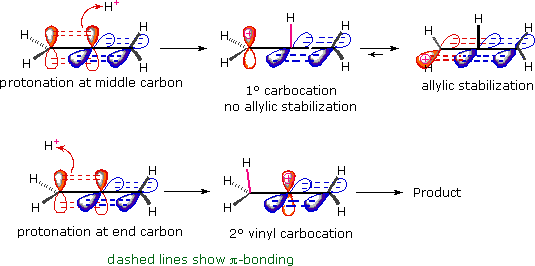
To understand why the reaction path proceeding by way of an allyl cation is not favored here we must recall the orthogonal orientation of the two pi-electron systems. As shown in the following diagram, protonation of the center, sp-hybridized, carbon atom generates an allyl-like carbocation, but the empty p-orbital of this cation (red) is initially oriented 90° to the π-orbital (blue) of the adjacent double bond, so no conjugation can occur. In order to acquire the stabilization and charge delocalization expected for an allyl cation, a 90° rotation about the bond joining the carbocation to the double bond must take place. Since this can only occur after the carbocation is fully formed, the transition state for central carbon protonation has the high activation energy associated with any 1°-carbocation formation. Indeed, the inductive effect of the adjacent double bond probably raises the transition state energy even further. Consequently, formation of a 2°-vinyl cation by protonation at an end carbon (bottom equation) is kinetically favored.
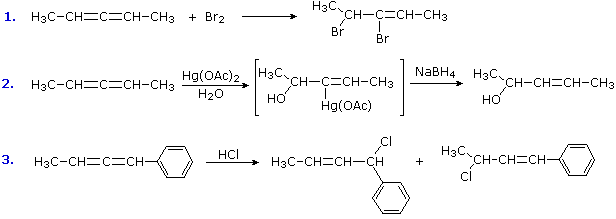
Some other addition reactions to allenes are shown in the following equations. The first example demonstrates that bromine adds readily to one of the allene double bonds. The inductive effect of the halogens retards addition of a second equivalent of bromine, but this may take place under more forcing conditions. The oxymercuration example results in nucleophile (water) bonding to a terminal carbon, probably because SN2 opening of the cyclic mercurinium intermediate is favored at that site. The last example is interesting because it shows that independent stabilization of a terminal carbocation, e.g. by benzyl resonance, changes the initial site of electrophilic attack to the central (sp-hybridized) carbon. The resulting stabilized cation may then achieve further stabilization by rotating to conjugate with the remaining double bond. The two isomeric addition products shown here come from nucleophile bonding at both ends of the resulting allyl cation intermediate.