Specialized Acylation Reagents and Techniques
Because acylation is such an important and widely used transformation, many novel techniques have been developed for this purpose. A few of these are described here.
Carbodiimides and Related Reagents
The ideal acylating reagent would be a carboxylic acid, but the acids themselves are relatively
unreactive with nucleophiles. A simple solution to this inactivity,
as noted earlier, was
to convert the carboxylic acid to a more reactive derivative such as an acyl chloride or
anhydride. A less extreme alternative procedure, often used in difficult cases, makes use of
reagents which selectively activate a carboxyl group toward nucleophilic substitution. Two such
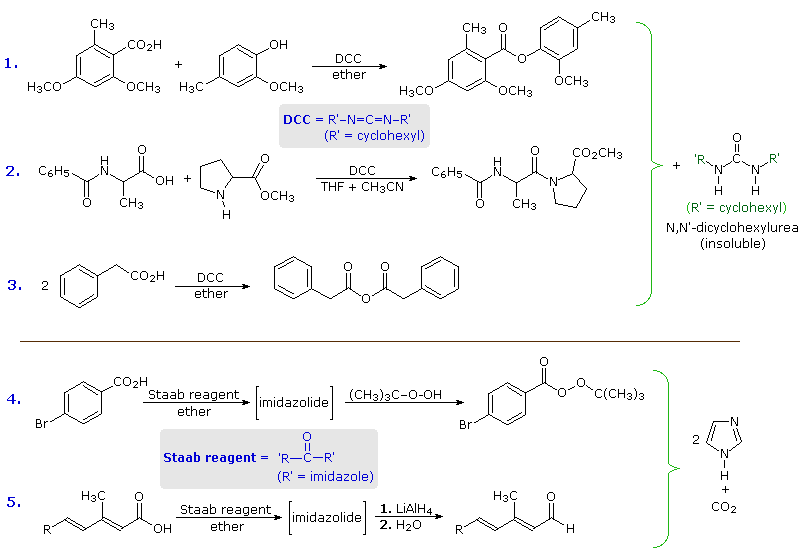
reagents are dicyclohexylcarbodiimide (DCC) and carbonyldiimidazole (Staab's
reagent). The following equations provide examples of their use in the preparation of esters,
amides, anhydrides and peresters. Indeed, LAH reduction of the imidazolide intermediate generated
by the Staab reagent provides a useful preparation of aldehydes from acids.
The mechanisms by
which these reagents activate carboxylic acids are displayed by clicking the "Show Mechanisms" button. Keep in mind that imidazole is a stronger acid than water and a better leaving group
than hydroxide anion, especially if protonated.
Vilsmeier Reagent
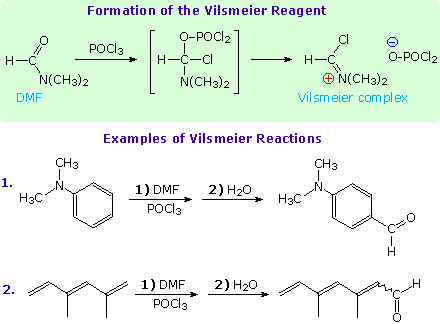
Unstrained neutral amides are notoriously poor acylating agents. However, electrophilic attack usually occurs at oxygen, and 3°-amides are activated by such an event. A useful application of this concept is the generation of an electrophilic formylating reagent by reaction of dimethylformamide (DMF) with phosphorus oxychloride, as shown in the green shaded box below. Note that the structural formula of the resulting complex resembles that of an acyl chloride, with the iminium double bond providing additional electrophilic character. This reagent, known as the Vilsmeier-Haack reagent, attacks nucleophilic substrates to generate formylated products. Two examples are shown below the reagent box.
Ketenes
Acyl chlorides having at least one alpha-hydrogen undergo elimination of HCl on treatment with 3°-amine bases (1st equation below). The resulting carbon-carbon double bond has a cumulative relationship to the carbonyl double bond, and compounds of this kind are called ketenes. Elimination of vicinal dichlorides by reaction with zinc dust is also possible (2nd equation), and thermal dehydration of acetic acid generates the parent structure, named ketene (3rd equation).
|
1. R2CHCOCl + R'3N
|
|
2. Cl3CCOCl + Zn (dust)
|
|
3. CH3CO2H + AlPO4 & heat
|
 R2C=C=O
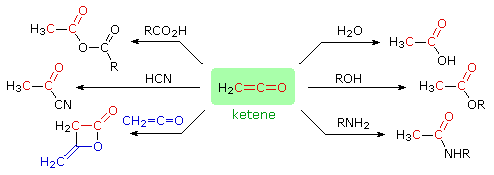
 Ketenes are reactive intermediates which combine rapidly with nucleophiles to give carboxylic acid derivatives or, if no other reaction is possible, eventually dimerize (or polymerize). Some characteristic reactions of ketene are shown in the following diagram. The β-lactone structure at the lower left is a stable compound known as diketene.