The Diels-Alder Reaction: Thermodynamics
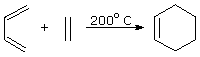
The group of [4 + 2] cycloaddition reactions referred to as the Diels-Alder reaction constitute one of the most versatile and widely used synthetic methods. Stripped to its most basic components, this reaction is represented by the addition of 1,3-butadiene to ethene shown below. The standard state thermodynamic functions for this reaction may be calculated from the heats of formation and entropies of the components.
|
||
|---|---|---|
| ΔH° = -40 kcal/mole | ΔS° = -43.6 cal/ °K mole | ΔG° = -27 kcal/mole kcal/mole |
The exothermic nature of this reaction is the result of converting two weak π-bonds into two
stronger σ-bonds. The large negative entropy reflects the change from two independent reactant
molecules to one product molecule, and the necessity of fixing the diene in a cisoid conformation.
Both impose increasing order on the system. Because the entropy factor opposes the enthalpy
change, the calculated ΔG° is smaller than ΔH° by 298*ΔS°/1000, but it still represents a strongly
exergonic reaction. Despite the favorable overall energy change, this reaction has a substantial
free energy of activation, and requires heating to take place. At 200 °C the TΔS° component
increases to 20.6 kcal/mole, but ΔG° remains a strongly exergonic -19.4 kcal/mole. The calculated
equilibrium constant favoring cyclohexene at this temperature is therefore greater than
1012.
Functional substituents on the dienophile or diene reactants often lower the
activation barrier, and in some cases spontaneous [4 + 2] additions may occur. Examples include:
1,3-butadiene + maleic anhydride, 1,3-cyclopentadiene + propenal, and 1,3-cyclohexadiene +
dimethyl acetylenedicarboxylate.
It is interesting to note that a commercial process for preparing 1,3-butadiene consists of passing gaseous cyclohexene over a red hot metal coil (ca. 900 °C), as shown in the following equation.
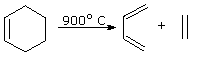
This is the reverse of the Diels-Alder cycloaddition, and the thermodynamic functions for this reaction will have opposite signs to those defined above. Using these standard state functions, the success of this procedure can be explained. At 900 °C (1173 °K) the entropy component is larger than the enthalpy component, so the ΔG for the decomposition is an exergonic -11.1 kcal/mole. This is equivalent to an equilibrium constant of 108, favoring the desired butadiene, which is easily separated from ethene thanks to its higher boiling point (-4.5 °C). It should be noted that ΔH and ΔS are not constant at all temperatures, but do not normally suffer large changes.
Dimerization of Cyclopentadiene
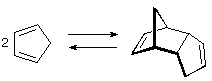
A similar Diels-Alder system that is more easily studied is the dimerization of 1,3-cyclopentadiene shown below. The ΔH° for this reaction is almost 10 kcal/mole lower than that of the butadiene + ethene addition, reflecting strain in the tricyclic product. The ΔS°, on the other hand, is roughly 10 eu less negative as a result of the fixed cisoid orientation of the diene.
ΔH° = -18.4 kcal/mole
ΔS° = -34 cal/ °K mole
ΔG° = -8.3 kcal/mole kcal/mole
ΔH‡ = +15 kcal/mole
ΔS‡ = -32 cal/ °K mole
ΔG‡ =
+24.5 kcal/mole kcal/mole
At room temperature cyclopentadiene slowly dimerizes, the exergonic ΔG° corresponding to an equilibrium constant of 106 in favor of the dimer. The ΔG‡ prohibits immediate reaction, but a sample of pure cyclopentadiene at room temperature slowly dimerizes over a week or two. Consequently, the short shelf life of the synthetically important monomer demands that it be freshly prepared just before it is used in a reaction. This is easily accomplished by heating the dimer to just below its boiling point (170 °C) and collecting the lower boiling monomer (b.p. 42 °C) as it is formed. Although the ΔG for dimerization is still negative at 170 °C (-3.3 kcal/mole), it has been substantially lowered by the TΔS° factor, permitting a significant equilibrium concentration of the monomer to be achieved.
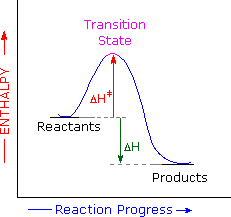
The availability of activation parameters for this reaction makes it possible to explore further details of the reaction path. The stereospecificity of the Diels-Alder reaction implies a single step transformation, and the exothermic character of the reaction requires an enthalpy profile similar to that shown on the right. The Hammond Postulate, which uses ΔH° as an indicator, suggests that the transition state would resemble the reactants more than the products. However, the similar magnitude and sign of ΔS° and ΔS‡ requires the transition state to have a structure very similar to the dimer product. This disagreement is a warning that the Hammond postulate was intended to be used for reaction profiles involving high energy intermediates., and is probably inappropriate for single step reactions such as SN2 substitutions and the Diels-Alder cycloaddition.
The symmetry analysis of this cycloaddition is developed in Orbital Correlation Diagrams.