Selective Oxidation Reactions
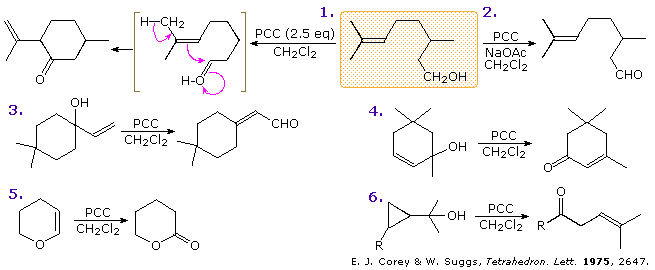
Two commonly used reagents for the oxidation of 1°- and 2°-alcohols are PCC and PDC. The following diagram displays some of the selective and synthetically useful reaction that these oxidants can achieve. The first display consists of PCC reactions, and on clicking the diagram a set of PDC reactions will appear. The aggressive nature of PCC is apparent in examples 1, 3, 4 & 6. Because of its acidic nature, PCC may induce cyclization to a nearby alkene (1), rearrangement of allylic 3°-alcohols (3 & 4), or an equivalent ring opening rearrangement of strained rings (6). Buffering with sodium acetate helps to reduce acid-related events, as in example 2. In the absence of sensitive functions, this reagent is the best choice for the straightforward conversion of alcohols to aldehydes and ketones.
PDC is a milder and more selective oxidant, as the examples on the second display demonstrate. As a rule, PDC oxidations are slower and may be catalyzed by a few drops of acetic acid. Allylic alcohols are oxidized much faster than corresponding saturated compounds, as evidenced by the prostaglandin in reaction 9. A curious solvent effect is observed for PDC oxidations. In methylene chloride solution the reaction of 1°- and 2°-saturated alcohols proceeds as expected but slowly (8 & 10). In DMF (N,N-dimethylformamide) 1°-alcohols are oxidized to carboxylic acids (7), and with added alcohol to esters (11). The mild nature of this reagent is demonstrated by the survival of the sensitive enol ether group in reaction 10.
Oxidation of Alcohols by DMSO
The conversion of 1° and 2°-alcohols to aldehydes and ketones, in its simplest form, can be considered a dehydrogenation (loss of H2). By providing an oxygen source to fix the product hydrogen as water, the endothermic dehydrogenation process may be converted to a more favorable exothermic one. One source of oxygen that has proven effective for the oxidation of alcohols is the simple sulfoxide solvent, DMSO. The reaction is operationally easy: a DMSO solution of the alcohol is treated with one of several electrophilic dehydrating reagents (E). The alcohol is oxidized; DMSO is reduced to dimethyl sulfide; and water is taken up by the electrophile. An amine base such as triethyl amine or pyridine is usually present in equimolar amount. Due to the exothermic nature of the reaction, it is usually run at -50 °C or lower. Co-solvents such as methylene chloride or THF are needed, since pure DMSO freezes at 18°. Although the dimethylsulfide byproduct has an unpleasant odor, it is easily rendered inoffensive by oxidation with sodium hypochlorite (Chlorox). A plausible general mechanism for this interesting and useful reaction is drawn below.
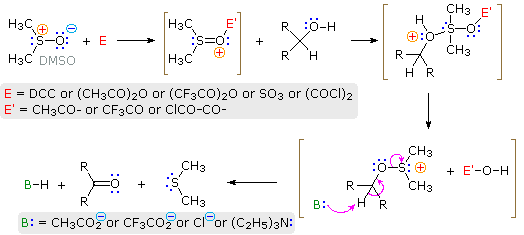
Because so many different electrophiles have been used to effect this oxidation, it is
unreasonable to propose a single universal mechanism. Most of the electrophiles are good
acylating reagents, so
one can expect an initial acylation of the sulfoxide oxygen. (The use of DCC as an acylation
reagent was
described elsewhere.) Acylation
enhances the electrophilic character of the sulfur atom. Bonding of the activated sulfur to the
alcohol oxygen atom then follows. The remaining steps are eliminations, similar in nature to those
proposed for other alcohol oxidations.
The most commonly used DMSO oxidation protocol is
known as the Swern Oxidation. In this procedure oxalyl chloride reacts with DMSO at low
temperature to form chlorodimethylsulfonium chloride, (CH3)2SCl(+)
Cl(–), which is the reactive species that oxidizes the alcohol. By clicking the above
diagram, a mechanism for the Swern oxidation will be displayed. Several variations of the final
elimination have been proposed, and two are shown within the bottom center bracket.
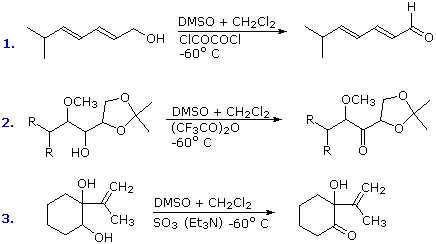
Three examples of these DMSO oxidations are given in the following diagram. Note that this oxidation procedure is very mild and tolerates a variety of other functional groups, including those having oxidizable nitrogen and sulfur atoms.
Dess-Martin Periodinane Oxidations
Hypervalent iodine compounds have proven to be effective oxidation reagents, Among the most commonly used of these is DMP, preparation of which from ortho-iodobenzoic acid is shown at the top of the following diagram. The alcohol to be oxidized is simply mixed with the periodinane in methylene chloride solution and stirred at room temperature. 1°-Alcohols give aldehydes and 2°-alcohols give ketones. The reagent and conditions are tolerant of many sensitive functions, such as acetals and silyl ethers. Two examples are shown in the diagram. A plausible mechanism is drawn on the right. The chief disadvantages of the Dess-Martin procedure are the explosive character of the IBX intermediate and the commercial cost of DMP, assuming the user does not wish to prepare it.
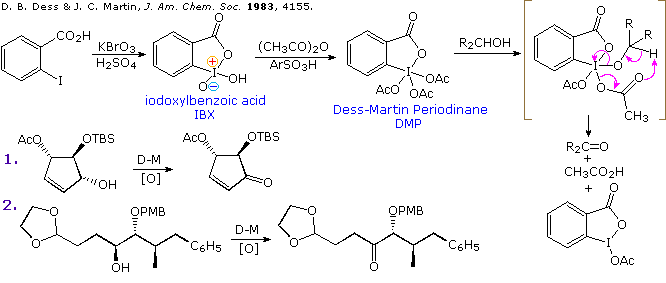
The more sensitive iodoxyl species (IBX) may be used directly as an oxidant, but it is relatively insoluble in nonpolar solvents. Nevertheless, it has been used to prepare ortho-quinones from para-substituted phenols, as shown in examples 3 and 4, displayed on the left above by clicking the diagram. Since ortho-quinones are quite reactive, they are normally not isolated, but are used in situ for various subsequent reactions. Quinones and azaquinones have also been synthesized from anilides by oxidation with DMP in mixed solvents, examples 5 and 6. In all these cases the substrate must have electron rich aromatic rings, and this method provides a useful alternative to Fremy's salt oxidations.
Selective Oxidation of Allylic and Benzylic Alcohols
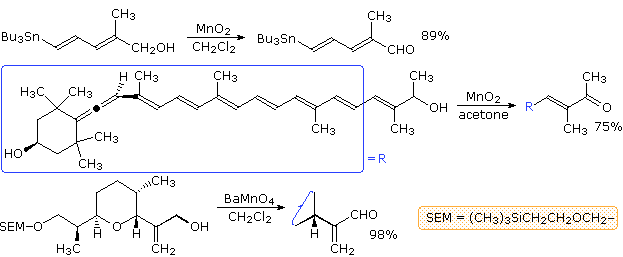
Allylic and benzylic alcohols may be oxidized selectively by a suspension of activated manganese dioxide in suitable organic solvents. Two examples are shown below. Similar oxidations have been effected by barium permanganate, as shown in the third example.
Catalyzed Oxidations
Chromium based oxidants are useful in the research laboratory, but their large scale use generates
toxic heavy metal waste products that must be disposed of carefully. Other oxidation reagents may
be expensive, unstable or otherwise problematic. In such situations, a fruitful strategy is to use
small (catalytic) quantities of the effective oxidant together with stoichiometric amounts of a
cheap and non-toxic oxidizing agent that is able to reform the active oxidant from its reduced
state. In the case of chromate reagents, one example of this approach is the reaction presented at
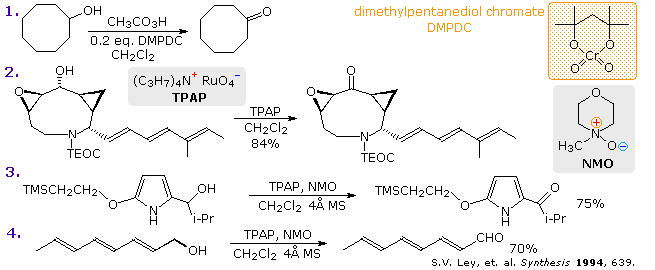
the top of the following diagram. Here, the cyclic chromate DMPDC acts to effect the oxidation of
cyclooctanol, and the reduced metal is reoxidized to Cr(VI) by the peracid. In a variant of this
procedure, excess peracid causes a
Baeyer-Villiger rearrangement of
the initial ketone product to form a lactone.
Ruthenium tetroxide is a powerful,
non-selective oxidant; however, the related tetra-n-propylammonium perruthenate anion,
TPAP, is a mild and selective oxidizing agent that is soluble in many organic solvents.
Although the reagent may be used in stoichiometric quantities (example 2), its expense (ca.
$100 per gram) and potential heavy metal problems have led to catalytic applications in which
N-methylmorpholine-N-oxide, NMO. serves as the stoichiometric oxidant.
Amine oxides are stable weak
oxidizing agents that are tolerant of most sensitive functional groups. The water formed in the
oxidation must be sequestered so it does not inhibit the catalyst, a function served by 4 Å
molecular sieve in reactions 3 and 4.
Unstable N-oxoammonium salts are mild and selective oxidizing agents that are easily generated
in situ from
nitroxyl radicals such as TEMPO.
This reactivity is outlined at the top of the new display activated by clicking on the above
diagram. The stoichiometric co-oxidant used in such reactions include sodium hypochlorite
(reaction 5), peresters, sodium bromite, oxone (reaction 6) and iodobenzene diacetate, another
hypervalent iodine compound used in reaction 7.
The use of oxone as a stoichiometric co-oxidant needs to be elaborated. This
triple salt, derived from Caro's acid (peroxymonosulfuric acid), is a relatively inexpensive
non-toxic solid having oxidizing power. Oxone is insoluble in most organic solvents, and is often
used in a buffered aqueous medium. As shown by example 6 above, a suspension of oxone in methylene
chloride or toluene is effective at reoxidizing the hydroxyl amine co-product; however, it is too
harsh for the selenium in example 7 (as well as sulfur and phosphorus analogs). In DMSO and DMF
suspension the rates of oxone oxidations are enhanced, and it has been observed that in DMF
aldehydes are efficiently converted to carboxylic acids. Furthermore, in alcohol suspension the
corresponding esters are obtained in high yield.

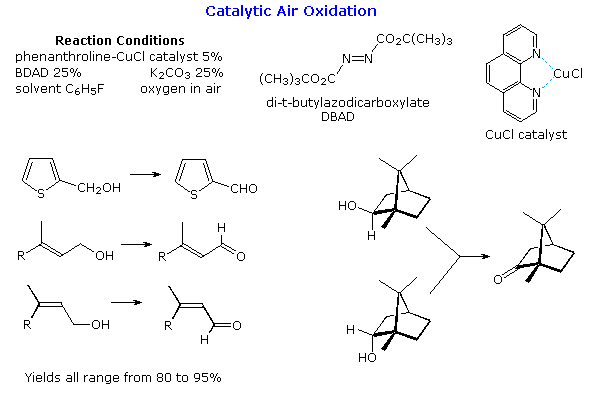
The ultimate in efficient and environmentally friendly catalytic oxidation was achieved recently
by researchers at Université catholique de Louvain and Zeneca Agrochemicals. A copper catalyst,
together with a hydrogen transfer agent is used to effect the air oxidation of 1°- and 2°-alcohols
to aldehydes and ketones respectively. As shown in the following diagram, this method does not
oxidize sulfides, and converts stereoisomeric allylic alcohols to carbonyl products without
isomerization. Also the epimeric 2°-alcohols on the right are oxidized at the same rate and in
excellent yield.
By clicking on the diagram, a catalytic cycle for this reaction will be displayed.