HomeReuschVirtual Textbook Chemical ReactivityMolecular Structure and Acidity

Molecular Structure and Acidity

Equilibrium Acidity

pKa Acidities of Some Common Hydrides

4 5 6 7
CH3-H
ca. 50
NH2-H
34
HO-H
15.74
F-H
3.2
HS-H
6.97 (pK1)
Cl-H
-3
HSe-H
3.8 (pK1)
Br-H
-6
HTe-H
2.6 (pK1)
I-H
-7

The relative acidities of different acids are commonly measured and cited as pKa values, relative to a standard solvent base, often water. These numbers reflect the equilibrium acidities of the acids. An astounding range of acidities is displayed by even rather simple compounds. The table on the right lists some elemental hydrides from groups 4 through 7 of the periodic table. The pKa's determined (or in some cases estimated) for these compounds are shown beneath the formulas. Approximate values for higher members of group 4 and 5 hydrides (e.g. silane and phosphine) have not been reported. Note that these logarithmic numbers encompass nearly sixty powers of ten. This is a greater span than that encompassed by distance measurements starting from the radius of a hydrogen atom and extending to the diameter of the known universe.

Why do these relatively simple compounds differ in acid strength so markedly? Two factors may be discerned:
• First, the compounds in the top row clearly show the importance of electronegativity. All the heavier elements have greater electronegativities than hydrogen, with carbon being the least different. The ionic character of these covalent bonds is such that hydrogen carries a partial positive charge, and the heavier atom a corresponding negative charge. The greatest charge separation is in H-F, where the electronegativity difference is nearly 2. Removal of a proton is facilitated by this charge separation. The covalent bond energies do not correlate inversely with acid strength, as one might have expected, since the two strongest acids have the strongest bonds (H–O 111 kcal/mol & H–F 135 kcal/mol). Finally, the heavy atoms in the top row have similar sizes, the covalent radii being 0.75 ±0.02 Å. The importance of this fact will become apparent in the next discussion.
• Second, the compounds in the columns representing periodic groups 6 and 7 show an increase in acidity moving from the top to the bottom. This is opposite to the electronegativity change, and is best attributed to an increase in heavy atom size. When an acid transfers a proton to a base, the remaining residue (the conjugate base) must carry a negative charge. Ignoring solvent stabilization (solvation), the stability of ions is a function of charge density. A small ion has a higher charge density than a larger ion of the same charge, making the smaller ion less stable. From the covalent radius of oxygen compared with sulfur, and fluorine compared with chlorine, it can be estimated that the charge density on the larger atom is half that of the smaller. The resulting stabilization of the conjugate base more than compensates for the decrease in electronegativity in moving down the column; so H2S is a stronger acid than H2O, and HCl a stronger acid than HF. Since sulfur and chlorine are nearly the same size ( covalent radii being 1.02 ±0.02 Å ), electronegativity explains the difference in acidity between H2S and HCl.

NH4(+)
9.24
OH3(+)
-1.74
S-H(–)
15 (pK2)
Se-H(–)
11 (pK2)

If the heavy atom of an acid carries a formal charge, its acidity will be changed substantially. This is demonstrated by the examples on the right. Ammonium and hydronium ions carry a positive charge, and the acidity of the species is increased by over fifteen powers of ten relative to uncharged ammonia and water. By contrast, hydrogen sulfide and hydrogen selenide are dibasic acids (they have two acidic protons). Once the first proton has been lost, the acidity of the negatively charged conjugate base is reduced over a million fold. This is true for most other dibasic acids such as H2SO4 and H2CO3.

Accurate acidity measurements in the pKa range from 1 to 14 can usually be made in water solution. However, acids stronger than the hydronium ion (H3O(+)) and bases stronger than hydroxide ion (OH(–)) react immediately with this solvent, and the resulting "leveling effect" prevents direct measurement of their pKa's. One way of circumventing this difficulty is to examine the acidity of very strong ( pKa < 0) and very weak ( pKa > 15) acids in different (non-aqueous) solvents, and to extrapolate these measurements to water. For example, solvents such as acetic acid, acetonitrile and nitromethane are often used for studying very strong acids. Very weakly acidic solvents such as DMSO, acetonitrile, toluene, amines and ammonia are used to study the acidities of very weak acids. The errors introduced in extreme cases, such as methane, are often large; but the overall range of acid strengths observed in this manner cannot be questioned.

Solvent Effects

Acidity

As noted earlier, a Brønsted acid base equilibrium involves a reversible proton transfer between a pair of acids and a pair of bases (referred to as conjugate pairs). The dissociation of a group of acids in a given solvent may be used as a measure of acid strength, and in such cases the solvent serves as a common reference base. The determination of Ka and pKa values for any solvent system may be carried out in the same way as in water; however, the acidities obtained for a group of acids measured in different solvents will generally be different, both in the numerical value for each, and sometimes in relative order.

A–H
an acid
+Sol:
solvent
equilibrium arrow
A:(–)
conjugate base
+Sol–H(+)
conjugate acid

There are several factors which influence acidity measurements made in water and other solvents. These are:

1. Ionization of an acid produces ions. Solvents having large dielectric constants favor charge formation and separation.
2. The conjugate acid from the solvent is a cation that is stabilized by association with other solvent molecules, a phenomenon called solvation.
3. The conjugate base of the acid is an anion, that in most cases is also stabilized by solvation.

As examples, consider the following data obtained for six strong acids in three common solvents.

Experimental pKa Values for Some Strong Acids in Different Solvents

Compound H2O DMSO CH3CN
HClO4 –10* –10* 1.6
CF3SO3H –10* –10* 2.6
HBr –9 0.8 5.8
HCl –7 1.8 10.4
H2SO4 –3 1.4 7.9
CF3CO2H –0.25 3.5 12.7
* Perchloric acid and trifluoromethanesulfonic acid are both completely ionized in water and DMSO.
The pKa value of –10 is approximate, and is intended to reflect the high degree of dissociation.

All three solvents have fairly high dielectric constants, but water (ε = 80) is significantly greater than DMSO (ε = 46.7) or acetonitrile (ε = 37.5). The greater acidity ( lower pKa ) of the last four compounds in water might be attributed to the dielectric difference; however, the superior anion solvation provided by water is considered to be the major factor. Both DMSO and acetonitrile are poor anion solvation solvents, consequently the ionization equilibrium shown above will be shifted to the left.

It is informative to focus first on the pKa differences between water and DMSO. We do this because water and DMSO have similar basicities, so stabilization of the solvent conjugate acid species should not differ substantially. HBr and HCl display pKas in DMSO that are roughly 9 to 10 powers of ten more positive than in water, and the weaker second period acid HF shows an even greater change (pKa = 3.17 in water & 15 in DMSO). The conjugate bases of these acids are all single atom anions. Because the negative charge is localized, anion stabilization by solvation is probably the most important factor in establishing the position of these equilibria. In contrast, the conjugate bases from sulfuric acid and trifluoroacetic acid are internally stabilized by charge delocalization over two or three oxygen atoms. The importance of solvation is therefore less important, and the shift in acidity in DMSO is reduced to 4 powers of ten.
When acetonitrile is the solvent, the measured pKas of these acids show a further increase, and even the strongest acids are not completely dissociated. This change may be attributed in large part to diminished solvation of the solvent conjugate acid, which is the chief cation species in dilute solutions. Since both the cationic and anionic species from acidic ionization are poorly stabilized by solvation, the dissociation equilibrium lies far to the left (no ionization).

Most organic compounds are much weaker acids than those listed above. It is therefore of interest to determine the changes in acidity that take place when such compounds are examined in the same three solvents. The first four compounds in the following table (shaded light green) are weak acids having conjugate bases in which the charge is localized on a single atom ( O, C & S ). Changing the solvent from water to DMSO decreases the acidity by 10 to 12 powers of ten for second period atoms ( C & O ), and by 6.5 for the third period sulfhydryl acid. Just as in the more acidic cases treated above, solvation of the conjugate base anions is an important stabilizing factor in water, although the lower charge density on sulfur reduces its significance. The further increase in pKa that occurs in acetonitrile solutions, relative to DMSO, is fairly uniform (10 to12 units) and a bit larger than the shift found for the strong acids.
The last four compounds (shaded blue) have conjugate bases stabilized by charge delocalization. Here, the decrease in acidity going from water to DMSO is lowered to 7 to 8 powers of ten for oxygen and is less than 4 for sulfur. As noted previously, charge delocalization within an anion reduces the importance of solvation stabilization. The increase in pKa found for acetonitrile solutions remains roughly the same, and may be attributed to poor solvation of the nitrile conjugate acid, as noted above.

Experimental pKas for Some Weak Acids in Different Solvents

Compound H2O DMSO CH3CN
C2H5OH 17 29 42
CF3CH2OH 12.4 23.5 33.5
C6H5C≡CH 19 29 40.6
C4H9SH 10.5 17 28.6
CH3CO2H 4.8 12.8 22.3
C6H5CO2H 4.2 11.1 20.7
C6H5OH 10 18 26.6
C6H5SH 6.6 10.3 20.6

With the exception of the acetylene derivative, the previous compounds are all heteroatom acids. Similar measurements for a group of activated carbon acids show agreement with the previous analysis, and illustrate the manner in which anionic charge delocalization reduces the pKa difference between water and DMSO measurements. Note the near identity of the second and third examples in the following table. As expected, the pKa increase in going to acetonitrile from DMSO remains roughly constant (ca. 11).

Experimental pKas for Some Carbon Acids in Different Solvents

Compound H2O DMSO CH3CN
(CH3CO)2CH2 9 13.3 24.4
(N≡C)2CH2 11.2 11.2 22.2
(C6H5SO2)2CH2 11.6 12.2 23.2
(C2H5OCO)2CH2 13.5 16.4 27.8
C4H4CH2
cyclopentadiene
15.0 18.0 31.2

Basicity

The most common notation for reporting relative base strengths is in terms of the pKa's of the corresponding conjugate acids ( these conjugate acids are often called "onium" cations ). The following equation shows the equilibrium involved in this relationship. Note that strong bases will have weakly acidic conjugate acids, so the pKa is proportional to the base strength of the base.

B–H(+)
conjugate acid
+Sol:
solvent
equilibrium arrow
B:
a base
+Sol–H(+)
conjugate acid

The previously defined factors that influenced acidity may now be reexamined for this new equilibrium.

1. Ions are present on both sides of the equation. Consequently, differences in the solvent dielectric constant should be a relatively unimportant factor.
2. The base and solvent conjugate acid cations are both stabilized by solvation. This will be a critical factor, and is related to solvent basicity.
3. There are no anions in the above equation; however charge neutralization requires a counter anion. Since the same anion will be present on both sides of the equation, its influence on this equilibrium will be canceled.

The following table gives pKa values for some commonly used nitrogen bases, some structures for which are shown to its right. In the triethylamine and DABCO examples at the top of the table, the cationic charge is relatively localized on a single nitrogen atom. The charge in lutidine may be delocalized onto ring carbons at the cost of aromatic stabilization. The last three examples are compounds in which the charge is delocalized by resonance (protonation occurs at the light blue nitrogen) or internal hydrogen bonding (the proton sponge).
In contrast to the earlier examples of acid pKas, the values for these ammonium cations are nearly identical in water and DMSO solvents. Indeed, the fact that most of the DMSO pKas are a bit lower than their water counterparts suggests that DMSO is slightly more basic than water. In acetonitrile all the pKa values are about 10 units higher than the DMSO values.

pKas for Some Ammonium Species in Different Solvents

Ammonium Cation H2O DMSO CH3CN
(C2H5)3N–H(+) 10.75 9.0 18.5
DABCO–H(+) 8.8 8.9 18.3
Lutidine–H(+) 6.75 4.45 14
DBU–H(+) 12 12 24.3
[(CH3)2N]2C=NR–H(+) 13.8 13.6 23.3
Proton Sponge–H(+) 12.3 7.5 ca. 18
Structures of nitrogen bases DABCO, lutidine, DBU, and 1,8-bis(dimethylamino)naphthalene proton sponge

The influence of solvent on acidity and basicity noted above may cause unexpected changes in simple acid-base equilibria. If acetic acid and triethyl amine are mixed together in water, a rapid proton transfer takes place to give nearly quantitative formation of triethyl ammonium acetate. The conjugate acids differ in strength by 106 and the weakest is favored at equilibrium. When the same two compounds are combined in DMSO solution there is negligible proton transfer, since acetic acid is now over 103 times weaker an acid than the triethyl ammonium cation.


Nonionic Superbases

The strongest bases available to organic chemists are alkali metal alkoxide salts, such as potassium tert.-butoxide, alkali metal alkyls, such as n-butyl lithium, and amide salts of alkali metals, such as LDA. These powerful bases are all potential nucleophiles (some more than others) and have partially ionic bonds to the metal. Recently, a new class of non-metallic, poorly nucleophilic, neutral bases have been prepared and studied. Some examples are shown in the following diagram.
The basic site in the Verkade base is the phosphorous atom, the conjugate acid being stabilized by transannular bonding to nitrogen. The strength of these bases may be modified by substituents on the flanking nitrogens. The Schwesinger phosphazene bases increase their strength as additional phosphazene units are added in conjugation with the basic site (the light blue nitrogen atom). All the pKas for these bases are measured in acetonitrile.

Verkade base protonation with transannular P-N bonding (pKa 29.6) and Schwesinger phosphazene bases P1, P2, P4 with pKas


Hybridization

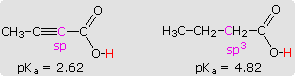
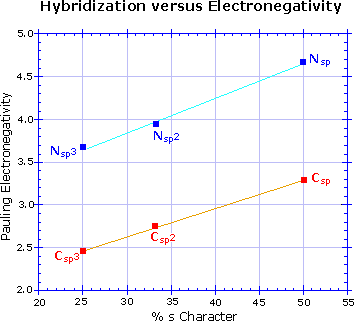
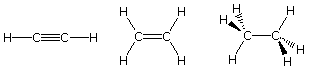
Hybridization has a strong influence on acidity, as shown by the three carbon acids on the upper left below. The greater the s-character of the orbital holding the electron pair of the conjugate base, the greater will be the stability of the base. This corresponds to the lower energy of an s-orbital compared with p-orbitals in the same valence shell. It also corresponds to the increased electronegativity or inductive electron withdrawal that is found for different hybridization states of a given atom, as depicted in the graph on the right. The difference in acidity of 2-butynoic acid and butanoic acid, shown in the shaded box at lower left, provides a further illustration of this inductive effect.
Carbocation stability is also influenced by hybridization, but in the opposite direction (sp3 > sp2 > sp).

Carbon Acids

Three carbon acids: acetylene (sp), ethylene (sp2), and ethane (sp3) showing hybridization of C-H bonds
Hybridization

pKa (H2O)
sp

25
sp2

44-48
sp3

50-55


Inductive Effect

2-butynoic acid (sp, pKa 2.62) more acidic than butanoic acid (sp3, pKa 4.82), illustrating inductive effect of hybridization
Graph of Pauling electronegativity vs percent s-character for C and N at sp3, sp2, sp hybridization; both rise with s-character


Stereoelectronic Control of Enolization

Many carbon acids have enhanced acidity because of a neighboring functional group. The acidity of alpha hydrogens in aldehydes, ketones and esters is well documented, and is the source of many important synthetic procedures. The following equation illustrates the general enolate anion transformation, with the acidic alpha-hydrogen colored red. The resulting ambident anion is stabilized by charge delocalization, and may react with electrophiles at both carbon and oxygen.
Stereoelectronic factors govern the enolization reaction, as illustrated by clicking on the diagram below. The bond from the alpha carbon to the acidic alpha-hydrogen must be oriented 90º to the plane of the carbonyl group, or parallel to the pi-electron system (colored magenta here). The ideal overlap occurs with a 0º dihedral angle between this bond and the pi-orbital, as shown.
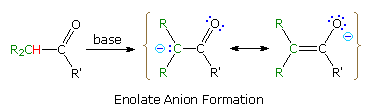
Enolate anion formation: ketone deprotonated by base to a resonance-stabilized ambident anion (carbanion and enolate forms)

By clicking on the diagram a second time, the importance of this stereoelectronic requirement will be demonstrated. An increase in the acidity of carbon acids activated by two carbonyl groups is well known, and is illustrated by the two beta-dicarbonyl compounds on the left side of the diagram. In such cases the acidic C-H unit may be oriented perpendicular to both carbonyl groups, and the resulting planar anion is stabilized by additional charge delocalization (over both oxygens and the central carbon). In the case of the bicyclic diketone on the right, the C-H bond nearly eclipses the two carbonyl C-O bonds, resulting in a dihedral angle with the pi-electron systems of roughly 90º. Consequently, the acidity of this hydrogen is similar to that of the hydrogens of an alkane or cycloalkane. It should also be apparent that if an enolate anion were to be formed to the bridgehead carbon, the double bond would be prohibited by Bredt's rule.


Kinetic Acidity

The most common acid-base terminology, pKa , reflects an equilibrium acidity, extrapolated or normalized to water. In the following equation a base, B:(–) M(+), abstracts a proton from an acid, H-A, to form a conjugate acid - base pair (A:(–) M(+) & B-H). The rate of the forward proton abstraction is k f , and the reverse rate of proton transfer is k r. This kind of equilibrium is usually characterized by an equilibrium constant, Keq, which is the ratio of the rate constants (k f / k r). If H-A is a weaker acid than H-B the equilibrium will lie to the left, and Keq will be smaller than 1.

H-A + B:(–) M(+) equilibrium arrow A:(–) M(+) + B-H
(acid1)(base1) (base2)(acid2)

In cases where H-A is very much weaker than H-B, Keq may be too small to measure, but it may be possible to determine the rate of the forward proton abstraction under certain circumstances. If an isotopically labeled conjugate acid of the base is used as a solvent for the reaction (B-D in the following equations), then any proton abstraction that occurs will be marked by conversion of H-A to D-A. The green shaded top equation shows the initial loss of the proton, and the second equation describes the rapid deuteration of the intermediate conjugate base, A:(–). As these reactions proceed, the H-A reactant will be increasingly labeled as D-A, and the rate of isotope exchange will indicate the kinetic acidity of H-A. It is assumed that kinetic acidity is roughly proportional to equilibrium (thermodynamic) acidity, but this is not always true.

solvent = B-D
H-A + B:(–) M(+) equilibrium arrow A:(–) M(+) + B-H
D-A + B:(–) M(+) equilibrium arrow A:(–) M(+) + B-D

The following diagram provides an instructive example of these principles. The first equation, in the yellow shaded box, provides important information about heavy water (deuterium oxide), which will be used as a solvent for our experiment. Heavy water is similar to water in many respects, but is 10% more dense and a ten-fold weaker acid. A 1 molar concentration of sodium deuteroxide will serve as the base, and an equimolar quantity of 3,3-dimethyl-1-butyne will serve as the weak acid. The most acidic hydrogen in this hydrocarbon (colored red) is at C-1. In practice, we would need to use a co-solvent to completely dissolve the hydrocarbon in the heavy water, but this has been omitted in order to simplify the discussion.
The second equation describes the essential changes expected on combining these reactants in the heavy water solvent. Since the terminal alkyne is a much weaker acid than heavy water, acid-base equilibria do not favor its conjugate base. Nevertheless, if the acetylide anion is formed, even in low concentration, it should react quickly by abstracting a deuterium from a neighboring deuterium oxide molecule. The result would be an observable exchange of deuterium for hydrogen, testifying that an acid-base reaction has occurred.

H/D exchange of 3,3-dimethyl-1-butyne in D2O/NaOD with Keq and kinetic analysis showing fast deuteration despite tiny equilibrium

The green shaded box contains equations that help us to interpret the experimental results. In order to evaluate the equilibrium acidity of the substrate, we would need to measure the equilibrium constant Keq for the initial acid-base equilibrium, shown at the top of the shaded box. Since we know the Ka 's of 3,3-dimethyl-1-butyne and heavy water, we can estimate Keq by dividing the former (10 -25) by the latter (10 -17). This calculation reveals a Keq that would be difficult to measure directly because of its small magnitude (10 -8). Indeed, the equilibrium concentration of acetylide anion is estimated to be only 2*!0 -10 M.
If we examine this experiment from the viewpoint of kinetics, easily observable evidence of terminal alkyne acidity is obtained. The last three rows of equations in the green shaded box make this clear. Since Keq is the ratio of forward and reverse rate constants, it is possible to draw conclusions about the rate of terminal proton abstraction from the alkyne. This leads to the conclusion that reasonably rapid hydrogen-deuterium exchange will occur, even though the acetylide anion is never present in concentrations exceeding 10 -9 M.

This example also demonstrates the limits of the isotope exchange approach. The 3,3-dimethyl-1-butyne substrate also has nine other hydrogen atoms (colored orange) that do not exchange with deuterium under these conditions. We know that these hydrogens are much less acidic (Ka ca. 10 -48), and it is interesting to consider their potential participation in acid-base reactions by the previous analysis. The estimated Keq for such carbanion formation is ca.10 -30, taking into account the nine-fold increase in concentration. This implies a concentration of one carbanion in every 109 liters of solution. The kinetic analysis is equally discouraging. The forward rate constant is estimated to be 10 -20 Ms-1. The time required to exchange half these hydrogens for deuterium would therefore be about 1010 centuries!
In order to study the kinetic acidity of extremely weak acids (pKa's = 30 to 50) it is necessary to use much stronger bases, which of course have much weaker conjugate acids. Amide anions (pKa's = 26 to 36) have been used for this purpose.

By comparing the rates of hydrogen exchange for different compounds under identical conditions, tables of relative kinetic acidities may be assembled. An interesting example of such a study has been reported for a group of nitroalkanes having acidic α-hydrogens. Compared with the terminal alkyne discussed above, such nitroalkanes are relatively strong C-H acids. Removal of an α-hydrogen by a base generates a conjugate base called an aci-anion, as shown here.

R2CH-NO2 + B:(–) M(+) equilibrium arrow R2C=NO2(–) M(+) + B-H
nitro compound aci-conjugate base

Compound pKa Relative Rate
of Exchange
CH3NO2 10.2 120
CH3CH2NO2 8.5 20
(CH3)2CHNO2 7.7 1.0

Since the nitroalkanes used in this study are stronger acids than water, the kinetic exchange experiments must be conducted under milder conditions than those used for the terminal alkyne. This is achieved by using smaller base concentrations and lowering the temperature of the exchange reaction. Accurate pKa's of 2-nitropropane, nitroethane and nitromethane may be measured directly in aqueous solution. These kinetic and equilibrium acidities are listed in the table on the right. Note that for these three compounds, kinetic acidity changes in an opposite fashion to equilibrium acidity. The kinetic order seems to reflect steric hindrance and carbanion stability; whereas, the equilibria favor increased substitution of the aci-anion double bond.


Base-catalyzed isotope exchange studies of compounds incorporating more than one set of acidic hydrogens provides additional insight concerning the creation and use of nucleophilic conjugate bases. Ketones provide many examples of regioisomeric enolate base formation, and the following diagram shows two such cases. As noted in the nitroalkane study, hydrogens on an α-methyl group are exchanged more rapidly than those on more substituted α-carbon atoms. The equations in the diagram show only the initial product from a single exchange. These products have additional α-hydrogens which are also exchanged by subsequent reactions of this kind, so that complete replacement of all α-hydrogens by deuterium takes place in a short time.
The relative stability of the resulting enolates increases with substitution of the enolate double bond. Equations showing the equilibrium concentrations of these isomeric enolates will be displayed by clicking the Toggle Equations button. In order to determine enolate anion equilibria for these ketones, the bulky strong base sodium hexamethyldisilazide (pKa = 26) was used.

Regioselective enolate H/D exchange of 2-butanone and 3-methyl-2-butanone in NaOD/D2O; methyl alpha-H exchanges fastest

By clicking the Toggle Equations button a second time, the relative rates of α-hydrogen exchange for some substituted cyclohexanones will be displayed above. Once again, less substituted α-carbons exchange more rapidly, but more highly substituted enolates are found to predominate under equilibrium conditions. A third click of the Toggle Equations button will display an energy profile for the 2-methylcyclohexanone case, which should clarify the distinction between kinetic and equilibrium acidity. Two other examples are also shown. These displays may be cycled repeatedly.

Most carbon acids yield conjugate bases that are stabilized by charge delocalization onto neighboring heteroatoms. This resonance stabilization requires significant structural reorganization of the initial compound, which in turn imposes an energy barrier that retards the rate of proton abstraction. For example, the alpha-carbon of a ketone or ester must undergo rehybridization as the enolate anion is formed. The stereoelectronic demands of this change were described above, and it is not surprising that enolate anion formation is much slower than equivalent proton transfers between alcohols and other hydroxylic compounds. Deprotonation rates of phenol and nitromethane, compounds with nearly identical pKa's (10.0), provide an instructive example of this structural reorganization factor. The acidic proton in phenol is bound to oxygen, so deprotonation requires little structure change and is very fast. Nitromethane is a carbon acid. Deprotonation to an aci-anion involves considerable structural change, and is a million times slower than phenolate formation. These structural changes are illustrated in the following diagram.

Deprotonation of phenol (minor reorganization, fast) vs nitromethane to aci-anion (major sp3-to-sp2 reorganization, slow)

Note that the O-H electron pair in phenol remains largely on oxygen in the corresponding conjugate base, whereas the C-H electron pair in nitromethane is predominantly shifted to oxygen in its conjugate base (colored blue).

The trends outlined here are a bit oversimplified, since solvent and cation influences have been ignored. For a discussion of these factors, and practical applications of enolate anion intermediates in synthesis Click Here.