Stable Carbonyl Hydrates and Hemiacetals
Although most aldehydes and ketones do not form stable hydrates or hemiacetals, a number of interesting exceptions are known. Some examples are shown here.
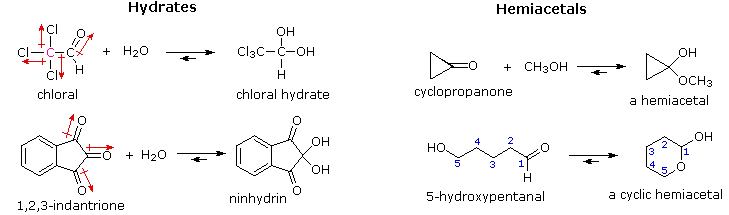
The factors that act to favor hydrate or hemiacetal formation include inductive charge repulsion (chloral) dipole repulsion (ninhydrin) and angle strain (cyclopropanaone). It is important to note that cases in which 5 or 6-membered cyclic hemiacetals can form usually favor such constitutions. The simple sugars offer many examples of this kind. Because these additions are readily reversible, all compounds of this type exhibit carbonyl-like chemical reactivity.