Transition State Aromaticity
In describing pericyclic reactions the reorganization of electrons may be represented by a cycle of curved arrows - each representing the movement of a pair of electrons. Many common pericyclic reactions having similar characteristics (e.g. [4+2] suprafacial cycloadditions & [1,5] sigmatropic shifts, as well as disrotatory electrocyclic reactions of trienes) require three curved arrows, and are therefore cyclic six-electron transformations. The similarity to the conjugated six π-electron ring of benzene has led many chemists to designate the cyclic transition states of these reactions as aromatic. Extending this viewpoint, we note that suprafacial [6+4] and [8+2] ten-electron cycloaddition reactions, but not [6+2] eight-electron cycloadditions have been observed. Likewise, six-electron [1,5] sigmatropic shifts are common, but four-electron [1,3] shifts are very rare. A comparison of these facts with the Hückel Rule for aromaticity is suggestive, leading to the designation of 4n+2 pericyclic reaction transition states as Hückel transition states.
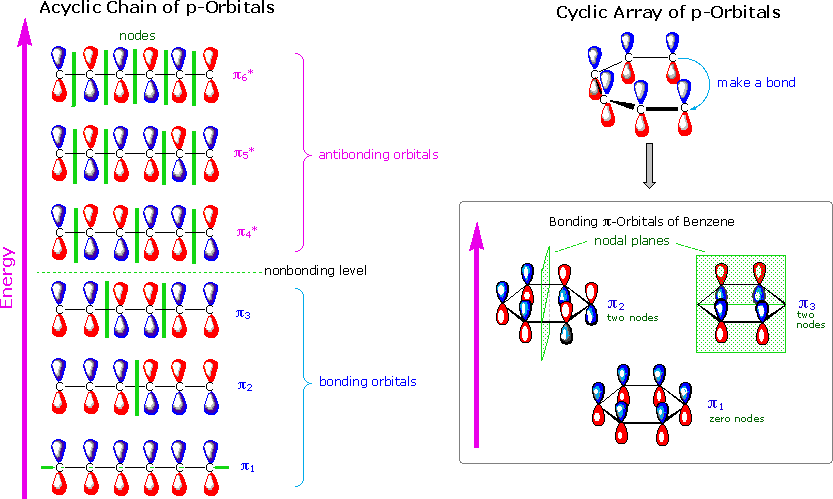
A short review of Hückel's contribution will be helpful in using this approach. A linear chain of
n conjugated p-atomic orbitals overlap to generate n π-molecular orbitals, as shown
for n=6 on the left of the following diagram. The lowest energy π-orbital has no nodal surface,
other than that defined by the plane of the molecule. The next higher energy orbital has one node,
perpendicular to the molecular plane (colored green), and the other orbitals have increasing
numbers of nodes, paralleling their different energies. The three lowest energy orbitals are
bonding, and the three highest energy orbitals are antibonding.
To examine a model of the p-orbital components of 1,3,5-hexatriene pi-orbitals.
Click Here
To examine the actual molecular orbitals of 1,3,5-hexatriene Click Here
If this linear array of p-orbitals is coiled so that the ends may be joined by a sigma bond, the resulting cyclic conjugated system (that of the annulene benzene) is markedly changed by the symmetry of the ring. Hückel showed that the six π-orbitals are now arrayed in four energy levels or shells. The lowest level has a single molecular orbital, but the next two levels each hold two equal energy (degenerate) orbitals. The last and highest energy orbital then occupies a fourth shell. As before, the three lowest energy orbitals (shown here) are bonding, and the others are antibonding. The number of nodes a given orbital has is determined by the number of phase changes encountered in one circuit of the ring. The degenerate bonding orbitals π2 and π3 each have two nodes where the nodal planes (colored green) intersect the ring. The complete set of benzene molecular orbitals was shown earlier in this text.
Benzene was not the only annulene described by Hückel, and a diagram displaying the π orbital
energies for ring sizes three to seven will be activated by clicking on the above diagram. These
Hückel annulenes (shown at the top of the diagram) are all characterized by a single lowest energy
π-orbital having no nodal surfaces, other than the plane of the molecule. Using the terminology of
atomic structure, this single orbital represents the first shell of the π-electron system. Pairs
of degenerate π orbitals make up the next electronic shells, as shown. The number of nodes
associated with each level increase by two, as the energy increases. Electrons are placed in these
orbital shells, starting with the lowest energy shell and moving to higher energy shells until all
the electrons have been assigned. The aromatic stabilization of benzene comes from its closed
shell electronic configuration, i.e. all the bonding orbitals are occupied by electron
pairs. Cyclobutadiene, the four membered annulene, has four π electrons, but these do not
completely fill the second (non-bonding) shell, and by Hund's rule would produce a diradical. The
instability of this 4n electron annulene is thus explained. Cyclopentadienyl anion and
cycloheptatrienyl cation both have closed shell configurations and are exceptionally stable
relative to other organic ions. Hückel concluded that annulenes having 4n+2 π-electrons would
exhibit enhanced (aromatic) stabilization, but those having 4n electrons (e.g. cyclobutadiene)
would be especially unstable.
The bottom section of the diagram describes a novel set of
annulenes created by twisting the p-orbital array before joining the ends. This causes a node or
phase change at this junction, and the resulting π-orbitals have been called
Möbius orbitals by H. Zimmerman (Wisconsin), in reference to the well known topological
surface. The calculated energy levels for these orbitals are shown in the bottom section of the
diagram. In contrast to Hückel annulenes, Möbius annulenes have two degenerate π-orbitals in the
first shell. Pairs of degenerate orbitals occupy the remaining shells, so a closed shell
configuration will necessarily have 4n π-electrons. Such 4n configurations are expected to have
aromatic-like stability. No stable Möbius annulenes are known, but a search for such compounds is
ongoing. Because the twist in such annulenes disrupts orbital overlap, only large rings are likely
to accommodate this feature while retaining conjugation.
An elegant synthesis of a bridged. 16 π-electron Möbius annulene has been reported.
For
further information
Click Here.
The unique characteristics of Hückel and Möbius molecular orbital arrays may be used to analyze
pericyclic reactions, thanks to the cyclic movement of electron pairs in their transition states.
For example, a suprafacial configuration in cycloaddition and sigmatropic shift reactions is
possible without introducing a node into the orbital interactions. Consequently, such reactions
have Hückel transition states and will be favored by systems having 4n+2 electron transition
states. Similar reactions involving 4n electron shifts will be favored by a Möbius configuration
having a node, as in an antarafacial configuration.
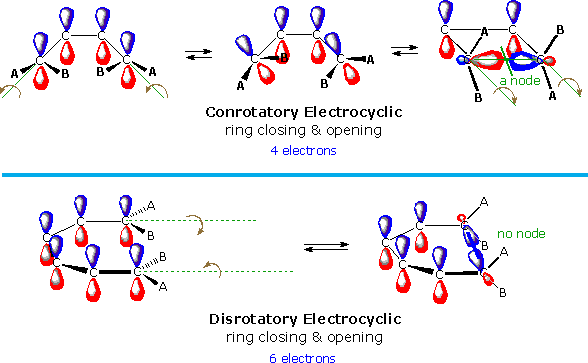
The two electrocyclic reactions shown
below further illustrate this approach. The four-electron example at the top proceeds best by way
of a Möbius transition state, so the conrotatory movement involving a node at the sigma bonding
site is favored. The second example is a six-electron transformation, and this should occur by way
of a Hückel transition state. The absence of a node in that transition state requires a
disrotatory movement during the ring closure or opening.