Writing Reaction Mechanisms
When a chemical reaction takes place, the atoms and associated electrons of the reacting molecular
species reorganize to form new product molecules and ions. The overall structural changes are
normally evident once the products have been identified, but the manner in which these changes
take place is less obvious. In order to represent and keep track of the electron reorganization
involved in a reaction, chemists find it useful to depict the way in which key electron pairs (or
single electrons) move to accommodate the breaking of existing bonds and the making of new bonds.
Curved arrow symbols are a convenient
tool for this purpose, and a complete representation of all the electron shifts in a reaction is
called its mechanism.
As a rule, only the valence shell electrons of atoms are
involved in a chemical reaction, and only a few of these electrons actually change their location.
Electron pair shifts are the most common events in most mechanisms, and are the subject of this
discussion. Single (or odd) electron shift mechanisms are described in the
Free Radical section of this text. Valence
shell electron pairs will either be bonding or non-bonding. The placement of curved
arrows for these pairs will be slightly different. This is illustrated by the two equations in the
following diagram. Non bonding electron pairs usually participate in a reaction by forming a
covalent bond to another atom. Bonding electron pairs may shift to form a new covalent bond, or to
become a non-bonding electron pair. By clicking on this diagram, these changes will be identified
by color coding.
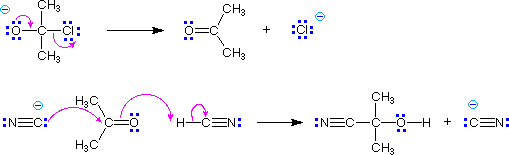
In these examples the foot of the curved arrow (the end opposite to the head) is placed at the initial location of an electron pair that is going to shift its position. If this is a bonding electron pair that should be the center of the bond. The head of the arrow then points to the pair's final location – either an atom if it becomes non-bonding, or the space where a new bond will be formed. If the new bond will be a π-bond, this should be the center of the already existing σ-bond. If the new bond will be a σ-bond, the arrow should clearly identify the atom that will share the electron pair.
In cases where full or partial charges are present, the direction in which arrows are drawn should be evident. Remember, a curved arrow shows the movement of an electron pair in the direction to which the head points, and nucleophiles generally bond to electrophiles. The previous two equations are typical examples. In other cases, especially when a cycle of arrows is drawn, the direction may not be clear and may not even matter. Two examples of such cyclic arrays are shown in the following equations. The first describes the resonance π-electron delocalization in benzene. The second is a Diels-Alder cycloaddition reaction between symmetrically substituted reactants.

In reactions where the distribution of electrons is not symmetrical, the direction in which curved arrows are drawn may be significant. One such case is the thermal decarboxylation of acetoacetic acid shown below. A concerted mechanism consisting of cyclic shifts of electron pairs may be drawn, and two such examples are shown below. Although both mechanisms lead to the products in the light blue box, the mechanism on the left (green arrow) is a more plausible representation than that on the right, because it reflects the acidic character of the carboxylic acid and the basic character of a carbonyl oxygen.
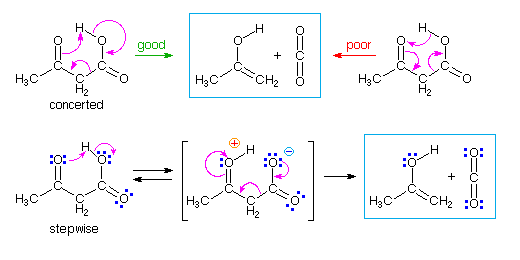
This distinction is clearly seen in the two-step mechanism written in the second row of the diagram. The initial proton transfer proceeds in the expected fashion, and the remaining electron shifts are the same as those in the green arrow concerted mechanism. There is no evidence supporting a two-step pathway for this decarboxylation, but it is possible that the proton transfer stage leads the concerted cyclic sequence.
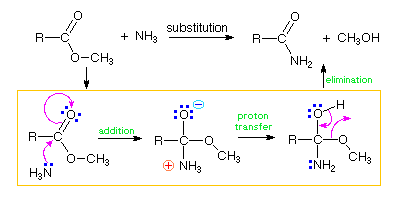
The preceding example is nevertheless a warning that many reactions do take place in a stepwise fashion, and the mechanisms we write must recognize such cases. The conversion of an ester to an amide by reaction with ammonia, as shown below, is such an example. At first glance this seems to be a substitution reaction, and it would be possible to draw curved arrows for a concerted mechanism, as depicted in the box on the far right. In fact, this reaction, and other acyl transfer reactions, take place by an addition-elimination sequence, as drawn in the boxed space beneath the overall reaction equation. The concerted mechanism on the right is therefore an erroneous conjecture. Thus we have a useful warning that "arrow pushing" does not always lead to plausible interpretations of reaction mechanisms. Experimental support for any mechanism is highly desirable if not essential.
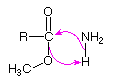
This is not a plausible mechanism
Oxford University.