Chemistry of Aryne Intermediates
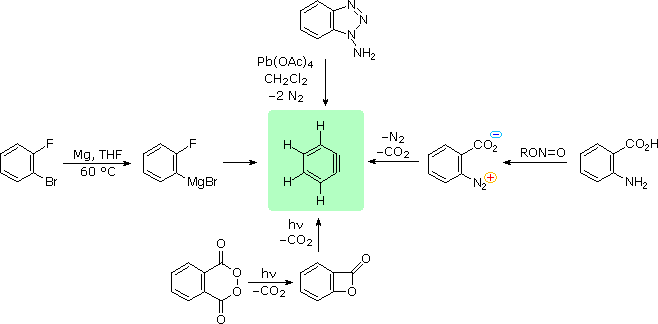
Benzyne, C6H4, is but one member of a group of highly reactive intermediates known as arynes. Several elimination procedures for the preparation of benzyne itself from ortho derivatives of benzene have been recorded, and typical examples are shown in the following diagram. As might be expected, the chief mode of reaction displayed by benzyne, and in general by arynes, is addition. Examples of such reactions will be displayed below by clicking on the diagram. Because benzyne (and other arynes) is a powerful dienophile, many of its addition reactions are cycloadditions. Note the pyridyne analog of benzyne in the bottom equation.
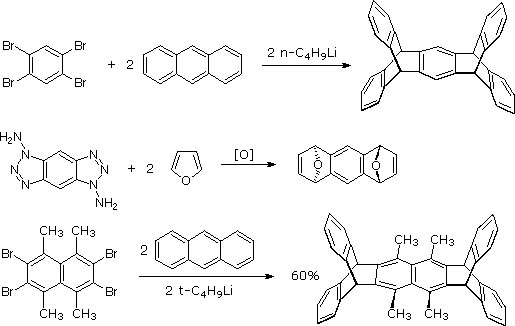
Arynes and diarynes have been put to use in the synthesis of multi-bridged aromatic ring molecules called iptycenes. A few examples are given in the following diagram. By clicking on the diagram, an application of aryne cycloaddition to a natural product synthesis will be displayed. In this case the aryne intermediate cycloadds to the substituted furan in a highly regioselective fashion, as shown in brackets. The initial adduct then undergoes a rapid eliminative ring opening to a naphthalene derivative.
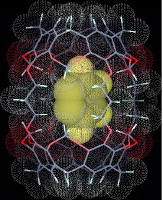
Although arynes are extremely reactive, it has been possible to examine them
spectroscopically in high vacuum molecular beams, and trapped in inert glass matrices at very low
temperature. As shown on the right, benzyne itself has been captured in a molecular cage, termed a
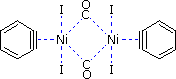
carcerand. Benzyne also forms stable π-complexes with certain transition metals, one example being
the nickel complex drawn below.
To examine a molecular model of benzyne Click Here.