Meso Compounds
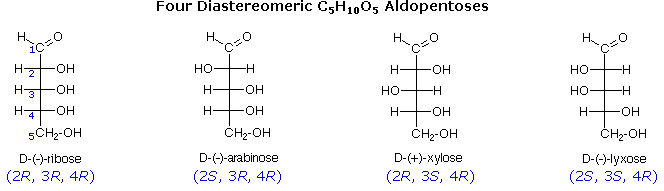
The four diastereomeric aldopentoses presented earlier and repeated above are all chiral. Each of these compounds has an enantiomer so, as expected, there are eight stereoisomers in all. By reducing the aldehyde function to a 1°-alcohol, the ends of the five-carbon chains become identical and the symmetry characteristics of the overall structure are such that the number of configurational stereoisomers falls from eight to four. These four isomers, shown below, are a pair of enantiomers and two meso-compounds.
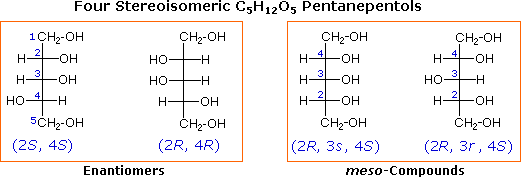
In the enantiomeric pair on the left, carbon #3 is not a stereogenic center, since interchanging the H and OH substituents at this carbon does not change the overall configuration. This is not true for the meso compounds on the right. Interchanging the H and OH substituents on carbon #3 converts one isomer into its achiral partner. Stereogenic centers such as C#3 have been called pseudoasymmetric centers, and a configurational notation (r or s) may be assigned by noting that an R substituent is above an equivalent S substituent in the sequence rule (note the lower case letters used for this notation). The chain numbering on the right has changed, because in nearly symmetrical cases the nearest R center has precedent over a similarly oriented S center in determining the primary end of the chain.