Cheletropic Addition of SO₂
A cheletropic reaction has been defined as a process in which two sigma bonds which are directed to a single atom of a ring are made or broken concertedly. The number of pi-bonds decrease or increase by one, depending on the direction of the reaction (ring-forming or ring-opening). An example is the reversible addition of sulfur dioxide to 1,3-butadiene shown here.
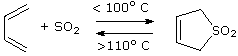
ΔH° = –16.5 kcal/mole
The direction taken by this reaction depends upon the temperature. Below 100° C the equilibrium favors the addition product, the standard heat of reaction being –16.5 kcal/mole. Above 100° C the cyclic sulfone decomposes to 1,3-butadiene. The equilibrium constant is close to unity at 100° C. If we assume this is true, the entropy change is easily calculated using the equations:
|
|
Since ΔG = 0 when Keq = 1, ΔS° = – 16,500/373 = – 44.24 cal/ °K mole.
At 25° C
the ΔG° = -3.3 kcal/mole, corresponding to a Keq = 270.