Carbonyl Reactivity and IR Stretching Frequency
Differences in the carbonyl stretching frequencies of carboxylic acid derivatives provide a useful diagnostic tool for distinguishing these compounds. Acetone is a useful reference compound (strong absorption at 1715 cm-1), since the methyl group substituents exert a minor inductive effect and do not carry a non-bonding electron pair. Electronegative substituents such as Cl, O & N withdraw σ-electron density from the carbonyl carbon atom, and also have a non-bonding electron pair(s) that can donate electron density by p-π overlap (resonance delocalization). As shown in the following figure, the inductive withdrawal of electron density increases the stretching frequency of the carbonyl group, whereas p-π overlap decreases the stretching frequency.
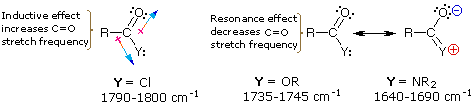
Chlorine exerts a strong inductive effect, but p-π delocalization is minor (note that chlorine substituents deactivate benzene in electrophilic substitution reactions). Oxygen also exerts a strong inductive effect, but the resonance effect is also strong and almost balances the former. Nitrogen is less electronegative than chlorine or oxygen, but its p-π resonance delocalization is very strong. Note that both oxygen and nitrogen substituents activate benzene toward electrophilic substitution reactions.
We have noted that nucleophilic substitution reactions of carboxylic acid derivatives proceed by
an
addition-elimination mechanism. The reactivity of these derivatives toward nucleophiles in general should reflect the
electrophilic character of the carbonyl carbon, so it is not surprising that those compounds
having the least p-π delocalization of charge (i.e. acyl chlorides) are most reactive. In other
words,
those compounds with the highest C=O stretching frequencies are the most reactive acylating
reagents.
Of course, these acylation reactions are also are influenced by and reflect the reactivity
of the nucleophilic reactant. A useful way of
evaluating the relative reactivities of anionic nucleophiles
is based on the pKa's of their corresponding conjugate acids. Weak acids have strong
(reactive) conjugate bases, and this often (but not always) parallels nucleophilicity. As
expected, negatively charged nucleophiles are generally much more reactive than the corresponding
neutral compounds.
The interplay of these two reactivity profiles (nucleophile and acyl derivative), in the context of the addition-elimination mechanism, provides a useful overview of this important reaction class. Four examples are illustrative:
i) Combination of a very reactive acylating reagent (an acyl chloride) with a strong nucleophile (R'O(–)) results in rapid reaction, even at ice bath temperatures. Both steps in this transformation appear to be fast, and the ester and chloride anion products are both stable.
R–CO–Cl + R'O(–)fast

R–CO–OR' + Cl(–)
ii) If the poorer neutral nucleophile ROH is combined with the same reactive acylating reagent a slower, but still spontaneous, reaction will occur. The first step is probably slower than the second, and the products are an ester together with solvated HCl.
R–CO–Cl + R'OHmoderate to fast
R–CO–OR' + HCl
iii) If a moderate nucleophile (e.g. R''NH2) and a moderate electrophile (e.g. an ester) are combined a reaction will often take place, but it may be rather slow. In this case the products (an amide and an alcohol) are both stable, and the first step is probably rate determining.
R–CO–OR' + R''NH2moderate to slow
R–CO–NHR'' + R'OH
iv) The products from (iii) are a poor nucleophile (R'OH) and a poor electrophile (an amide). The reverse acylation in this case is so slow as to be nonexistent, presumably due to a high activation barrier to the first (addition) step. Indeed, if water were used as the nucleophilic reactant (R'OH = H2O), the hydrolysis products would be stabilized by salt formation. Despite this thermodynamic advantage, hydrolysis reactions of amides are usually very slow.
R–CO–NHR'' + H2Oexceedingly slow
R–CO2(–) + R''NH3(+)
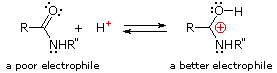
Unreactive combinations, such as that in case iv, can often be induced to react by heating or by introduction of acid or base catalysts. Heating provides energy to overcome a prohibitive activation energy barrier. Acid and base catalysts serve to generate more reactive species (electrophiles or nucleophiles) that facilitate the first step. In case iv these catalysts might function as follows:
| Acid Catalysis |
|
|---|---|
| Base Catalysis |

|
Note also that acidic or basic reaction conditions serve to stabilize one or the other of the hydrolysis products as a stabilized ion (ammonium or carboxylate).