The Cannizzaro Reaction
Reduction of aldehydes and ketones
to alcohols is most commonly carried out by metal hydride reagents, dissolving metal reagents, and
sometimes by catalytic hydrogenation. A table listing these reagents and the conditions under
which they are best used is available by
clicking here.
Prior to the development of these new and powerful reduction methods, the conversion of
carbonyl compounds to alcohols was often effected by hydrogen transfer from an alkoxide salt. This
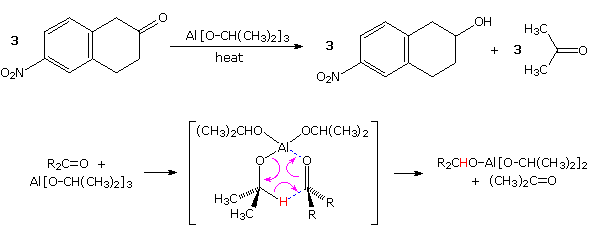
procedure, known as the Meerwein-Pondorf-Verley reaction, is illustrated by the following
equation and mechanism (the hydride-like hydrogen is colored red). Aluminum isopropoxide has been
the most common hydrogen source in most cases, but lanthanide salts, such as ROSmI2
have been used with good results. This reduction is specific for aldehyde and ketone carbonyl
functions, so other easily reduced functions such as nitro groups and halogen are unaffected.
By clicking on the above diagram, a second example of MVP reduction, which demonstrates the stereoselectivity of the reduction will be presented. Not only are two hydrogens delivered independently from the least hindered (convex) side of the cis-decalin substrate in example 1, but the easily reduced double bond of the enedione remains unchanged. The initially formed cis-diol undergoes lactonization with the neighboring methyl ester. It should be noted that a similar reductive hydride transfer takes place when large alkyl Grignard reagents react with hindered ketones, as shown in equation 2.
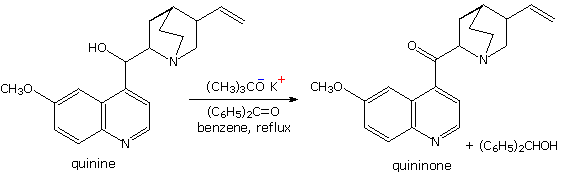
The MVP reduction is also an oxidation, as evidenced by the conversion of isopropoxide to acetone. Consequently, the reaction can be converted into an oxidation of alcohols to ketones or aldehydes. This procedure is called the Oppenauer oxidation. The reaction displayed below is an example of the Oppenauer oxidation in which benzophenone is the oxidant. Two significant features may be noted. First, the oxidation is specific for alcohols, and does not oxidize other sensitive functions such as amines and sulfides. Second, although aluminum or other coordinating metals are often used as cationic partners, alkali metals alone will suffice.
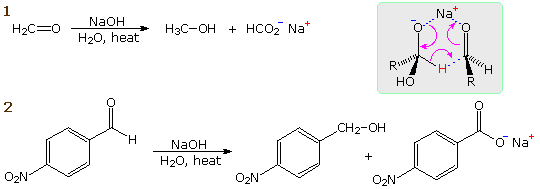
When a non-enolizable aldehyde is heated in strong aqueous base, a redox transformation known as
the Cannizzaro reaction takes place. Two examples are shown in the following diagram. In
the first, formaldehyde disproportionates into methanol and formic acid (sodium salt). In the
second, a benzaldehyde derivative is similarly converted into an equimolar mixture of the
corresponding benzyl alcohol and benzoic acid derivatives. A hydride transfer mechanism analogous
to that of the MVP reaction is drawn in the shaded box. If the Cannizzaro reaction is run in
D2O with NaOD as a base, no C-D incorporation is observed. Thus the new carbon-bonded
hydrogen in the alcohol cannot have come from the solvent.
It is important to remember that
the the Cannizzaro reaction is restricted to non-enolizable aldehydes. The strong base used for
this reaction would initiate aldol and other reactions that take place via enolate anions. A
useful crossed Cannizzaro reaction employs an excess of formaldehyde to reduce aryl aldehyde
substrates to 1 °-alcohols. The success of this procedure may be attributed to the high
concentration of the hydrate, H2C(OH)2, in aqueous solutions of
formaldehyde, making it the only significant hydride donor in the system.
An intramolecular Cannizzaro reaction, sometimes termed a Cannizzaro rearrangement will be displayed above by clicking on the diagram. A variant of the Cannizzaro reaction, known as the Tischenko reaction is also shown. In this reaction the alcohol and acid products combine to form an ester.