Solvation of Ions
Reactions which involve the formation of charged atoms and molecules are usually extremely
endothermic in the gas phase, but may become spontaneous in certain solvents. If ions are formed
from a neutral compound, as when NaCl is dissolved in water, the oppositely charged cations and
anions naturally attract each other, so formation of a dispersed homogeneous solution might appear
to be energetically unfavorable. To achieve charge separation of ions in solution, two solvent
characteristics are particularly important. The first is the ability of solvent molecules to
orient themselves between ions so as to attenuate the electrostatic force one ion exerts on the
other. This characteristic is a function of the polarity of the solvent. Solvent polarity
has been defined and measured in several different ways, one of the most common being the
dielectric constant, ε. High dielectric constant solvents such as water (ε=80), dimethyl
sulfoxide (ε=48) & N,N-dimethylformamide (ε=39), usually have
polar functional groups, and often high
dipole moments. When subject to the electric field of an ion, such polar molecules orient
themselves to oppose the field, and in so doing they limit its reach. Because of electrostatic
attraction between these polar groups, the boiling points of these solvents are generally higher
than those of similarly sized nonpolar solvents, such as diethyl ether (ε=4.3) and hexane
(ε=1.9).
Solvents that have relatively acidic hydrogen atoms (e.g. O-H & N-H) are called
protic. Because their functional groups are made up of polar covalent bonds, protic
solvents are often polar as well. A list of common protic and aprotic solvents is provided here.
The dielectric constants provide a measure of solvent polarity.
|
Protic Solvents |
Aprotic Solvents |
|||||
|---|---|---|---|---|---|---|
|
Compound |
Boiling Pt. |
Dielectric Const. |
Compound |
Boiling Pt. |
Dielectric Const. |
|
| Water | 100 °C | ε = 80 | DMSO | 189 °C | ε = 46.7 | |
| Formic Acid | 100° | 58.5 | DMF | 153° | 39 | |
| Ethylene Glycol | 197° | 37.7 | Nitromethane | 101° | 37.3 | |
| Methanol | 65° | 32.9 | Acetonitrile | 82° | 36.6 | |
| 2,2,2-Trifluoroethanol | 79° | 26.5 | Acetone | 56° | 20.7 | |
| Ethanol | 78° | 24.6 | Pyridine | 115° | 12.4 | |
| Ammonia | -33° | 22.4 | Methylene Chloride | 40° | 8.9 | |
| Isopropanol | 82° | 19.9 | Ethyl Acetate | 77° | 6.0 | |
| Acetic Acid | 118° | 6.2 | Diethyl Ether | 35° | 4.3 | |
| Diethyl Amine | 55° | 3.6 | Benzene | 80° | 2.3 | |
| Propanoic acid | 141° | 3.4 | Hexane | 69° | 1.9 | |
The second factor important in the stabilization of ions, which also resists their intimate recombination, is called solvation. This refers to the ability of solvent molecules to stabilize ions by encasing them in a sheath of weakly bonded solvent molecules, thus somewhat dispersing the electrical charge. Anions are best solvated by hydrogen-bonding solvents; cations are generally solvated by binding to nucleophilic sites on a solvent molecule Two-dimensional diagrams illustrating the primary solvation shell about Na(+) and Cl(–) are shown here. The water dipoles are drawn as red arrows, and partial charges are noted. Additional water molecules are oriented in secondary and tertiary layers about the ions.
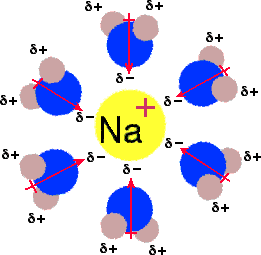
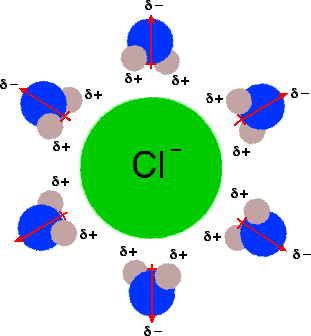
From this description of ion formation in solution, it should be clear that both enthalpy and entropy factors will be important to the outcome of an ionization process. Thus solvation stabilizes and insulates an ion, helping the enthalpic change, whereas the same solvation adds order and structure to the ionic species at the cost of lowering entropy. The outcome of these interactions is discussed below for two typical salts.
|
NaCl + H2O
|
ΔH° = +1.3 kcal/mole ΔS° = +10.3 cal/ °K mole ΔG° = –1.3 kcal/mole |
|||
|
CaF2 + H2O
|
ΔH° = +1.5 kcal/mole ΔS° = –36.3 cal/ °K mole ΔG° = +12.3 kcal/mole |
|||
 Na(+) + Cl(-)
Although these two inorganic salts have similar standard enthalpies of solution in water, their standard entropies are quite different. One might expect this entropy change to be positive, since a single molecule in the solid state produces two or more ionic species, accompanied by an increase in system disorder. However this argument fails to consider the ordering of solvent molecules taking place in the solvation of these ions. Because of their greater charge density, small ions and highly charged ions, such as F– and Ca2+, require greater solvation than large or singly charged ions, such as Na+ or Cl–. The overall entropy change for solution of NaCl is positive, reflecting the increased disorder of ionization, but the entropy change for CaF2 solution is strongly negative thanks to the solvation shell structure required by the resulting ions. These different entropy changes are incorporated in the free energy of solution, which is exergonic for NaCl, but endergonic for CaF2. The result is dramatic. Sodium chloride is quite soluble in water at room temperature (36g per 100g water), but calcium fluoride is nearly insoluble (0.0016g per 100g water).