Intramolecular Ene Reactions
The "ene" (C=C–Z–H) and "enophilic" (X=Y) moieties of an intramolecular ene reaction may assume different relative orientations that depend on the nature of the linking structure. The most common relationship is Type I, in which the enophile is joined to the alkene carbon farthest from the Z–H group. Type II reactions have the enophile joined to the alkene carbon bearing the Z–H group, and in Type III reactions the enophile is linked directly to the Z atom. These different arrangements are defined in the following diagram, where the X,Y & Z atoms are colored blue, and the transferred hydrogen is green.. Most intramolecular ene reactions, including earlier examples, are Type I.
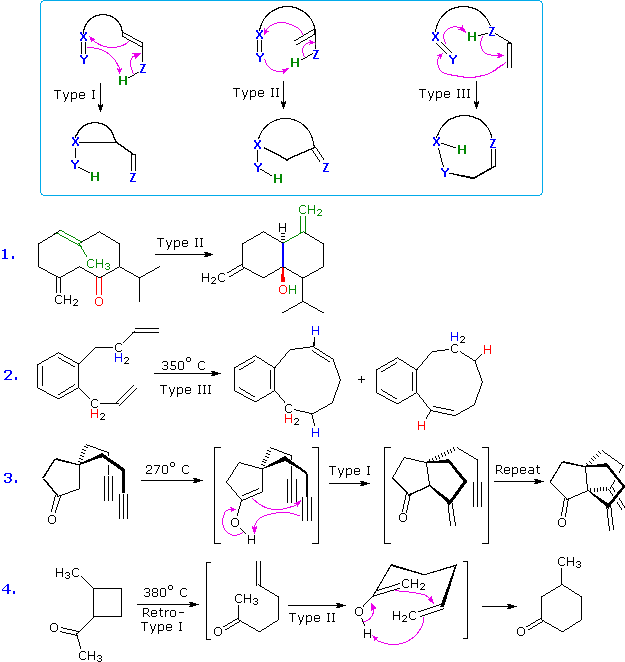
Equation 1. demonstrates a Type II ene reaction in which the enophile is a carbonyl group
(colored red). The alkene moiety is colored green, and the new sigma-bond is blue.
Equation
2. is a rare example of a Type III ene reaction. There are actually two different ene
reactions that take place, and these may be distinguished by the location of the product double
bond and the origin of the transferred hydrogen atom (colored red and blue in the above
illustration).
The last two examples show an interesting variant of the ene reaction in which
the enol tautomer of a carbonyl function serves as the "ene" component, and a carbon-carbon double
or triple bond is the "enophile". Reaction 3 has two equivalent alkyne chains suitably
oriented for a Type I reaction, and both engage sequentially to yield a novel tricyclic
"propellane" compound. There are two ene transformations in equation 4. The first is a Type
I retro ene reaction, facilitated by relief of ring strain. The second is a Type II ene
cyclization. An alternative Type III ring closure to 1-methyl-3-cyclohexenol does not occur.