Ester Cleavage Mechanisms
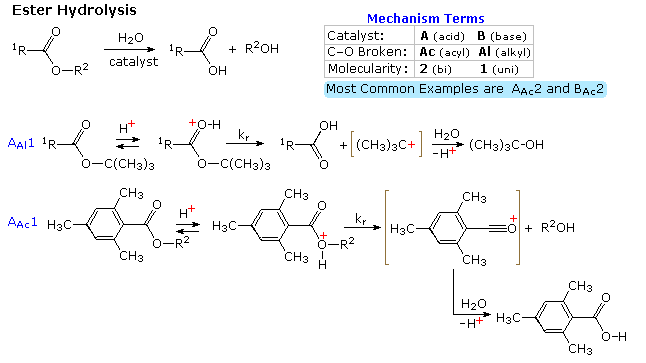
The common acid or base-catalyzed mechanisms for ester hydrolysis, which proceed by way of a tetrahedral intermediate, have been classified as AAc2 and BAc2 respectively. This notation refers to the nature of the catalysis (acid or base), the C–O bond which is broken (acyl-oxygen or alkyl-oxygen) and the molecularity of the rate-determining step (kr), as summarized in the following diagram. Equations illustrating two uncommon acid-catalyzed mechanisms, AAl1 and AAc1, are shown at the bottom.
Simple ethyl and methyl esters may react with negatively charged nucleophiles in two ways.
-
First, by the common BAc2 mechanism. This sequence leads to acyl transfer,
depending on the relative reaction rates, as shown below.
- Second, the nucleophile may react by SN2 displacement of carboxylate from the alkyl substituent of the ester, the BAl1 mechanism shown in the second equation below).
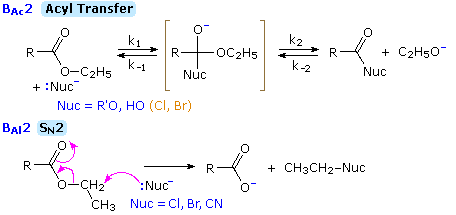
Base–catalyzed hydrolysis and ester exchange occur readily, in part because both the reacting nucleophile HO(–) or RO(–)) and the alkoxide leaving group have similar stabilities, and also because the tetrahedral anionic intermediate is formed relatively easily. In terms of the rate constants shown here, k–1 is comparable to k2, and k1/k–1 is not prohibitively small. On the other hand, good nucleophiles that are weak bases, such as Cl(–) and Br(–) will be essentially unreactive because k1/k–1 and k2/k–1 should be very small (<10–15), as estimated from pKa values.
The SN2 pathway requires a strong nucleophilic reactant, since carboxylate is not an exceptionally good leaving group. In polar aprotic solvents halide anions are an effective choice for cleaving methyl and ethyl esters, and alkali metal chloride and bromide salts dealkylate both methyl and ethyl esters in solvents such as DMSO, DMF and HMPTA. Furthermore, the influence of substituents on rates of SN2 reactions, allows selective cleavage of methyl esters compared with their ethyl counter parts. Thus, NaCN in HMPTA cleaves methyl esters in the presence of ethyl esters, and CH3CO2NH4 effects a similar conversion in hot DMSO.