Derivatives of Aldehydes and Ketones
Aldehyde and Ketone Derivatives
Kinetic vs. Equilibrium Control in Semicarbazone Formation
A striking demonstration of kinetic control vs. thermodynamic (equilibrium) control of products is provided by an experiment in which equimolar amounts of cyclohexanone, furfuraldehyde and semicarbazide are mixed in a buffered solvent at pH=5.
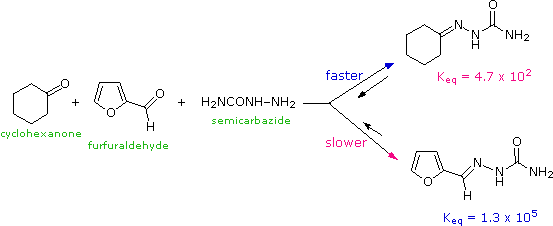
The semicarbazide reacts with cyclohexanone 60 times faster than it does with the aldehyde, and within 45 seconds a nearly quantitative amount of the semicarbazone derivative of cyclohexanone has precipitated and may be isolated by filtration. However, if the initial reaction mixture containing the cyclohexanone product is refluxed for a few hours an equally good yield of the more stable furfuraldehyde semicarbazone is obtained. Note that in both cases the semicarbazone derivative is favored over the initial reactants, but the equilibrium constant for the aldehyde is about 300 times greater than that of the ketone. The aldehyde semicarbazone is therefore the thermodynamically favored product, assuming there is equilibrium at all steps.
Dinitrophenylhydrazones
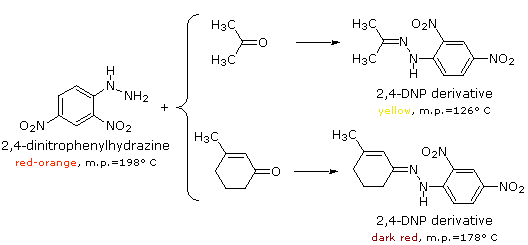
Another commonly used carbonyl derivative is prepared from 2,4-dinitrophenylhydrazine, as shown below. The reagent and its hydrazone derivatives are distinctively colored solids, which can be isolated easily. Saturated ketones and aldehydes are usually yellow to light orange in color. Conjugation of the carbonyl group with a double bond or benzene ring shifts the color to shades of red.
Aldehyde Derivatives
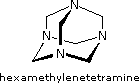
Among aldehydes, formaldehyde, H2C=O, has many unique properties. For example, with ammonia it reacts in a 3:2 ratio to give a tricyclic product, shown on the right, and known as hexamethylenetetramine. This interesting compound may function as an ammonia derivative for the synthesis of 1°-amines, or as a convenient high-melting source of formaldehyde by way of acid-catalyzed hydrolysis.
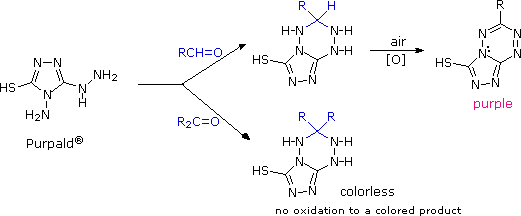
An interesting reagent that distinguishes aldehydes from ketones is the hydrazine derivative, 4-amino-3-hydrazino-5-mercapto-1,2,4-triazole, best known as Purpald (formula shown below). Although this reagent reacts with both aldehydes and ketones, only the aldehyde product is further oxidized to a purple, 10 π-electron aromatic heterocycle on exposure to air. Note that the pair of electrons on the nitrogen atom common to both rings is part of the π-electron system.