Unimolecular Syn-Eliminations
E2 elimination reactions are commonly bimolecular and prefer an anti-coplanar transition state. This important class of functional transformations is complimented by a small group of thermal, unimolecular syn-eliminations, described in the following table. The syn or suprafacial character of these eliminations is enforced by the 5- or 6-membered cyclic transition states (A & B) by which they take place.
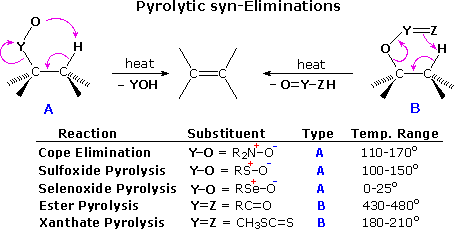
The temperature variations noted in the table suggest that these eliminations are facilitated by a negative charge on the O or Z atom and a low C–Y bond energy. Amine oxides have a full negative charge on the oxygen, and the Cope elimination proceeds well at temperatures near or slightly above 100 ºC. Together with the Hofmann elimination, Cope eliminations have proven useful for removing a permethylated amino group from a larger molecule. Sulfoxides are eliminated to sulfenic acids at roughly similar temperatures as the amine oxides. Here, oxygen charge neutralization by p-d bonding to the positive sulfur atom is balanced by the weaker C–S bond. Selenoxides eliminate rapidly at low temperature, reflecting a greater charge on oxygen due to poorer p-d bonding (selenium is much larger than oxygen), and a weak C–Se bond.
Although a six-membered transition state is relatively unstrained, esters and thioesters of alcohols require higher temperatures for elimination. This is expected because of the stronger C–O bond and the lower polarity of C=Z. The thioester function of xanthate derivatives of alcohols undergoes elimination at much lower temperatures than carboxylic esters, probably reflecting a favorable bond energy change from O–C=S in the xanthate to S–C=O in the eliminated fragment.
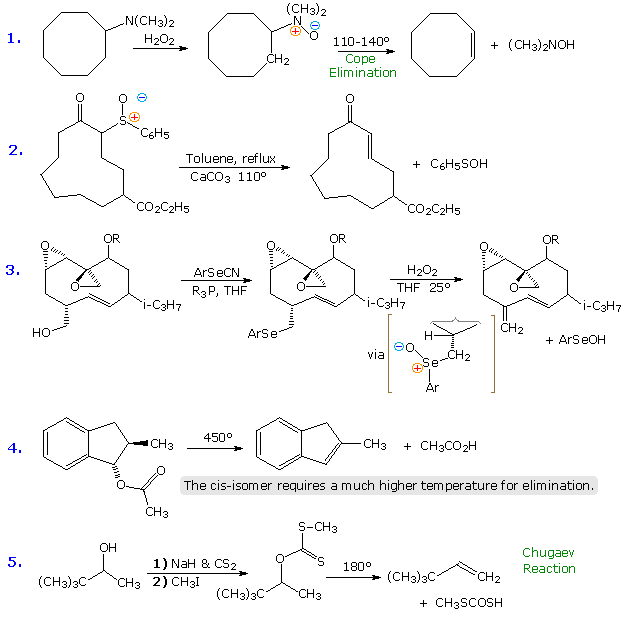
Some examples of these syn-thermal eliminations are given in the following diagram. The ester pyrolysis in equation # 4 demonstrates the importance of a cis-alignment of the eliminating groups, in this case the acetate ester and the vicinal hydrogen atom. Xanthate ester pyrolysis (equation # 5) is known as the Chugaev (or Tschugaev) reaction. Finally, the conversion of 1º-alcohols to aryl selenium ethers prior to selenoxide elimination, as in example # 3, is carried out via a hypervalent phosphorus species similar to that involved in the Mitsunobu reaction. The preferred aryl group in the selenocyanate reagent is o-nitrophenyl.
Aldehyde Ketone Reaction Summary
Preparation
- Commonly by oxidation of 1º & 2º-alcohols by chromium+6 reagents (e.g. PCC and Jones' reagent).
Reactions - Aldehydes are oxidized to carboxylic acids by Jones' reagent or Tollens' reagent. Ketones are not.
Both classes undergo the following chemical transformations: - Acetals and hemiacetals by reversible addition-elimination of alcohols. (acetals require removal of water)
- Imines and enamines by reversible addition-elimination of 1º & 2º-amines respectively. (removal of water is necessary)
- Cyanohydrins by reversible addition-elimination of HCN.
- Reduction to1º & 2º-alcohols by NaBH4 and LiAlH4 (irreversible hydride addition).
- Reduction to alkanes by Wolff-Kishner or Clemmensen conditions.
- Formation of 1º, 2º or 3º-alcohols by addition of organometallic reagents to formaldehyde, other aldehydes or ketones.
Carboxylic Acid Reaction Summary
Preparation - By oxidation of 1º -alcohols, hydrolysis of nitriles, carboxylation of organometallic reagents and oxidation of arene side-chains.
Reactions - Carboxylic acids are distinguished from other weak acids by reaction with sodium bicarbonate solution (gas evolution).
Chemical transformations: - Salts are formed by reaction with a base.
- Methyl esters are formed by reaction with diazomethane (CH2N2).
- Acyl chlorides (acid chlorides) are formed by reaction with thionyl chloride (SOCl2).
- Various esters are formed by reaction with alcohols and an acid catalyst (removal of water)
- Reduction to 1º-alcohols by .
- Formation of 1º-alcohols by LiAlH4 reduction.
Reaction Summary for Carboxylic Acid Derivatives
Preparation - By reactions of carboxylic acids; or by acyl transfer (see below).
Reactions
1. Acylation: - Acyl Chlorides
- Water reacts to give a carboxylic acid and HCl.
- Alcohols react to give esters and HCl.
- Carboxylate salts react to give anhydrides.
- Amines react to give amides and HCl (pyridine neutralizes the HCl).
- Anhydrides
- Water reacts to give the carboxylic acid.
- Alcohols react to give esters and a carboxylic acid. (base removes the acid)
- Amines react to give amides and a carboxylic acid. (base removes the acid)
- Esters
- Water reacts to give the carboxylic acid and the alcohol. (acid or base catalysis)
- Alcohols react to give a new ester and an alcohol. (acid or base catalysis)
- Amines react to give amides and an alcohol.
- Amides and Nitriles
- Water reacts to give the carboxylic acid and an amine or ammonia. (acid or base catalysis is necessary)
2. Reduction: - Acyl Chlorides are reduced to aldehydes by reduction with LiAlH(t-BuO)3, or by H2 and a poisoned catalyst.
- Esters are reduced to aldehydes by DIBAH at low temperature.
- Esters are reduced to 1º-alcohols by LiAlH4
- Amides and Nitriles are reduced to aldehydes by DIBAH at low temperature.
- Amides and Nitriles are reduced to amines by LiAlH4
3. Reaction with Organometallic Reagents: - Acyl Chlorides react with Gilman's reagent (R2CuLi) to give ketones.
- Nitriles react with Grignard reagent to give ketones (after hydrolysis of the imine product).
- Esters react with excess Grignard reagent to give 3º-alcohols. (2º-alcohols from formate esters)