Ether Protective Groups
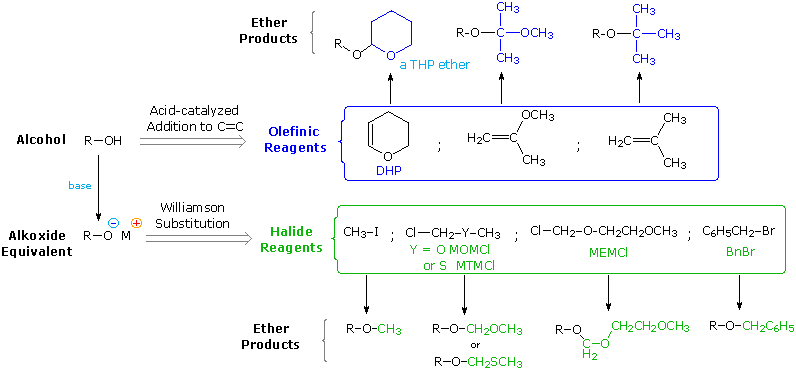
Thanks to their relative lack of chemical reactivity, ethers have proven to be useful protective groups for alcohols and phenols. By converting a hydroxyl function to an ether, its acidity and ease of oxidation (in the case of 1° and 2°-alcohols) can be suppressed to such a degree that normally incompatible reactions, such as those employing Grignard reagents, may be carried out. As outlined in the following diagram, many ether protective groups have been introduced to serve this purpose. Most of these are prepared by acid-catalyzed addition to an alkene or by Williamson alkylation by a suitable alkyl halide. Acronyms are used for common protective groups, an example being the THP (tetrahydropyranyl) ethers prepared from dihydropyran (DHP), as shown at top left.
Whenever a protective or blocking group is used to facilitate a synthetic operation, it normally
must be removed once the operation is complete. In this respect it is useful to have an assortment
of protective groups for which different chemical conditions accomplish this cleavage. The
protective groups listed above provide illustrations. Two of the acid-catalyzed addition
reactions, shown at the top left, generate acetal derivatives incorporating the alcohol moiety.
These acetals may be hydrolyzed by aqueous acid, with the THP derivative reacting more rapidly
than the acetone analog. The top right derivative is a tert-butyl ether, and this undergoes
acid-catalyzed cleavage under mild conditions in the absence of water (e.g. E1 elimination by
CF3CO2H at 0 °C).
The MOM (methoxymethyl) and MEM
(2-methoxyethoxymethyl) derivatives shown at the bottom are also acetals, but they are normally
prepared under nonacidic conditions. Of course, acid-catalyzed hydrolysis cleaves these acetals,
but the MEM derivatives are usually removed by treatment with ZnBr2 or TiCl4
in methylene chloride solution. The methylthiomethyl analog (MTM ether) is cleaved by mild
treatment with aqueous silver or mercury salts. Benzyl ethers (shown below on the right) may be
removed under a variety of conditions, including catalytic (Pd) hydrogenolysis, dissolving metal
reduction (Na in NH3) and HBr (mild).
The use of protective groups in a multistep synthesis is shown in the following diagram. Both hydroxyl groups in the top left compound are transformed to ethers (colored blue) to prevent them from perturbing subsequent reactions. First, the less hindered 1°-alcohol is converted to a THP derivative. The less reactive 3°-alcohol is then protected as a MEM ether.
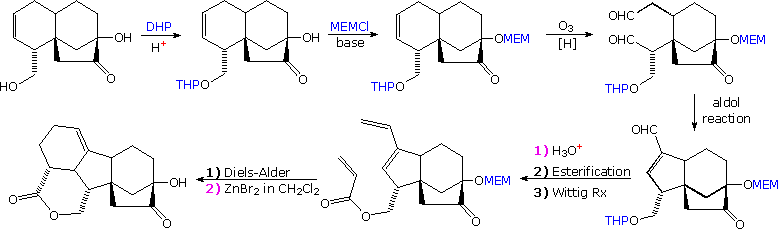
A series of synthetic operations follow, and eventually the THP group must be removed so that an acrylic ester may be made. Aqueous acid treatment (1) does this, leaving the MEM group in place. Finally, this protective group is removed by Lewis acid treatment (2).
Silyl Ethers
Alcohols react rapidly with trimethylsilyl chloride to give trimethylsilyl (TMS) ethers. Amine bases, such as triethylamine, pyridine or imidazole, are added to scavenge the HCl produced in the reaction. Other trialkylsilyl chlorides have been used in this reaction, as illustrated by the following equation.
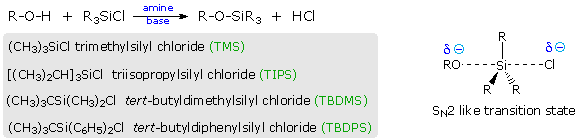
Unlike 3°-alkyl halides, these chlorosilanes undergo nucleophilic substitution by a mechanism
similar to the SN2. The exceptional strength of the Si–O bond combined with longer C–Si
bond lengths (less steric crowding) serve to stabilize such transition states (shown on the
right). Indeed, a pentavalent difluoride anion of this kind has been isolated and characterized.
The Si–F bond is substantially stronger than the Si–O bond, and helps to stabilize this species.
By clicking on the above the diagram its structure will be displayed.
TMS derivatives are
rather easily hydrolyzed to their alcohol precursors, but the bulkier silyl ethers are more
resistant and are stable over a wide pH range. These protective groups are readily cleaved by
fluoride anion, often introduced as a tetraalkylammonium salt.
Enolate anions react with
trialkylsilyl chlorides, generating silyl enol ethers by
substitution at oxygen. These
derivatives have proven useful as
enolate anion surrogates.